Who Pays for Your Rental Car After an Accident?

Who Pays for Your Rental Car After an Accident?

What to Do About a Rental Car After an Accident

Rental car after accident situations can be confusing — but here's the short answer:

Getting into a car accident is stressful enough. Then comes the next problem: how do you get around while your car is being repaired?

This is where most people hit a wall. Who actually pays? How long does coverage last? What if the other driver has no insurance?

The answers depend on a few key factors — whose fault the accident was, what coverage you carry, and how quickly you act. Nearly 59% of eligible drivers don't have rental reimbursement coverage, yet almost half of them still end up renting a car after filing a claim. That gap can mean hundreds of dollars in unexpected costs.

The good news: you have options, and knowing them upfront puts you in control.

I'm Tim Burd, and through running Justice Hero — a legal services company connecting accident victims with the right legal support — I've seen how a rental car after accident situation can quickly become a financial and logistical headache when people don't know their rights. This guide cuts through the confusion so you can get back on the road fast.
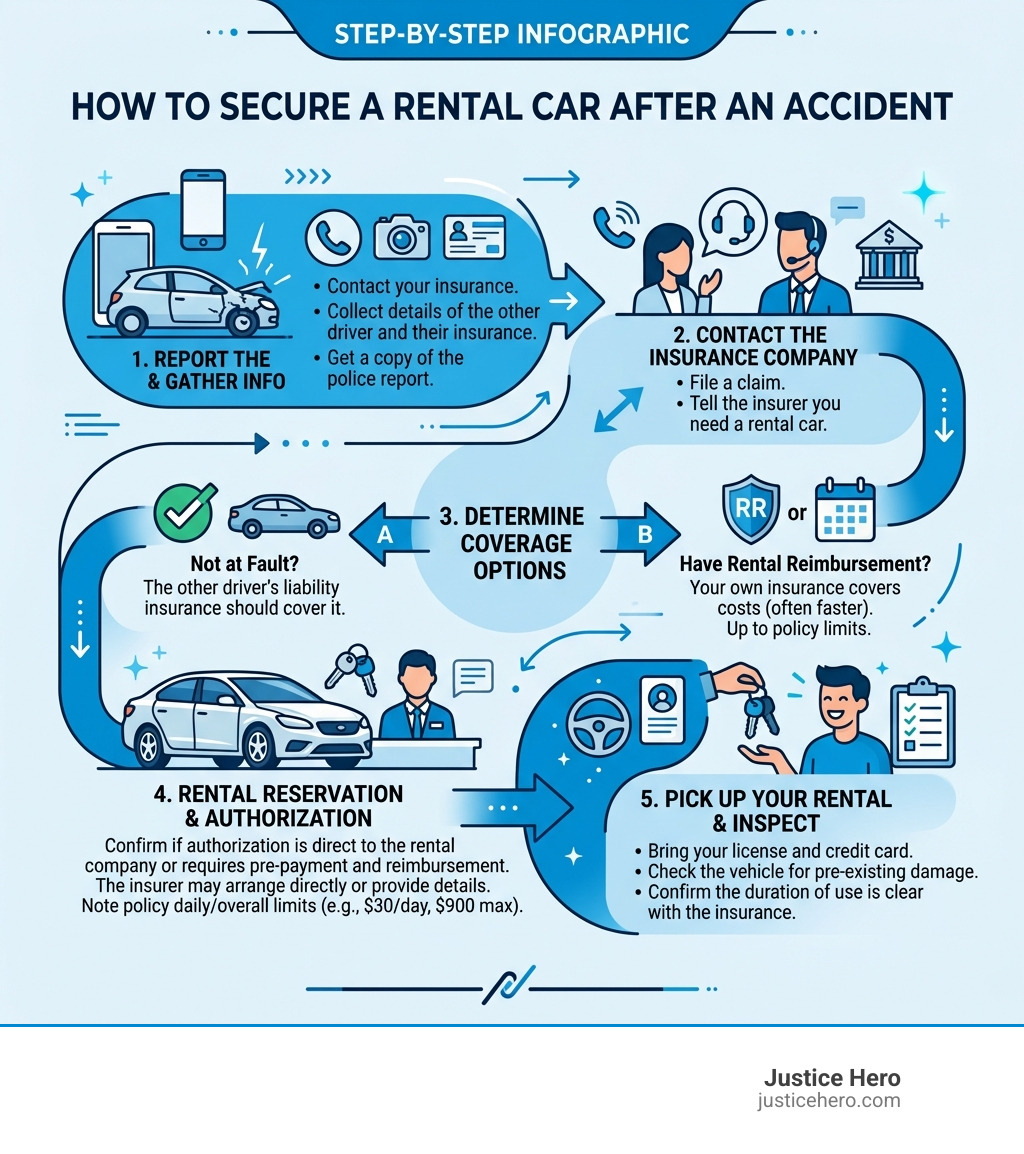
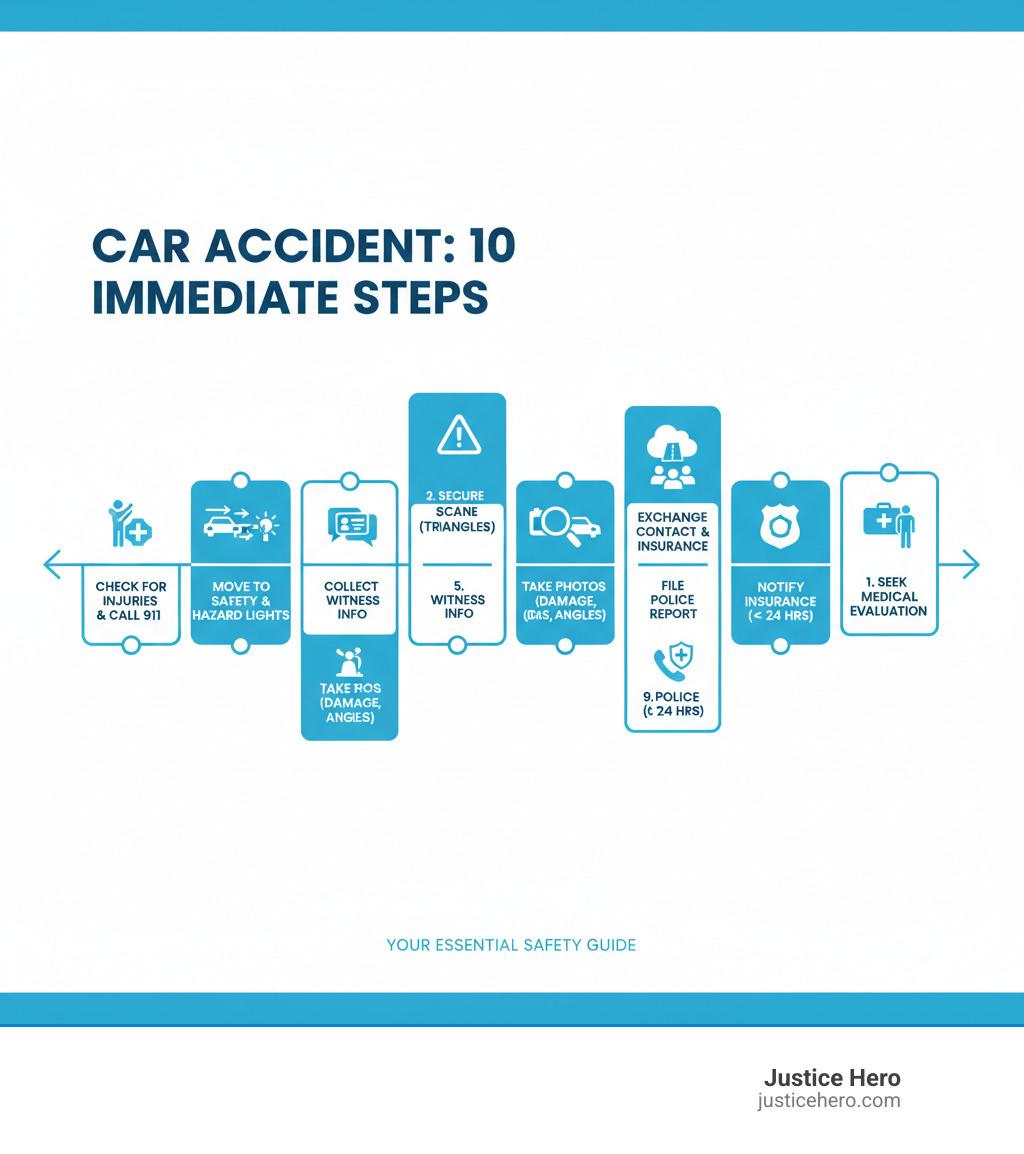
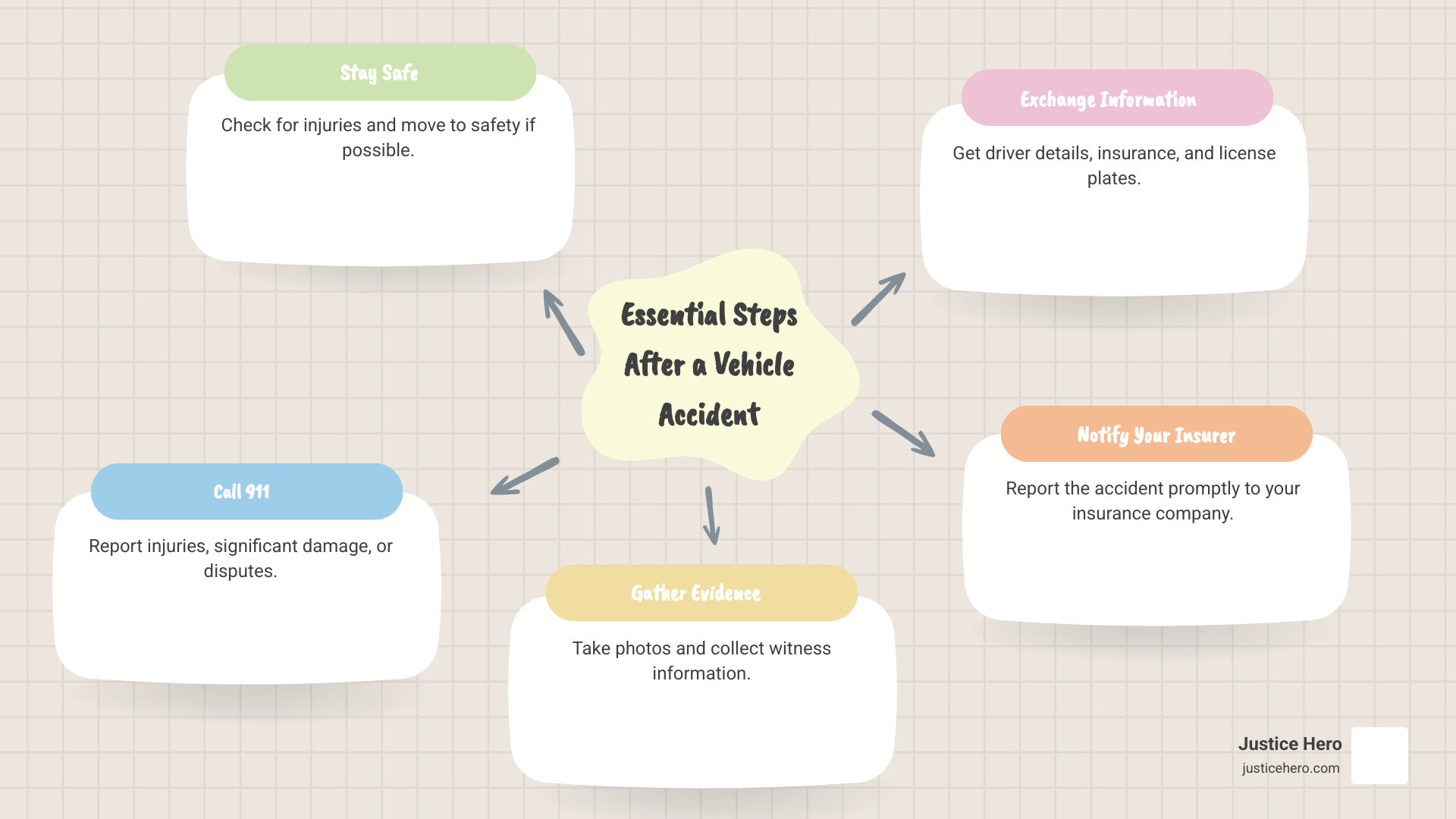
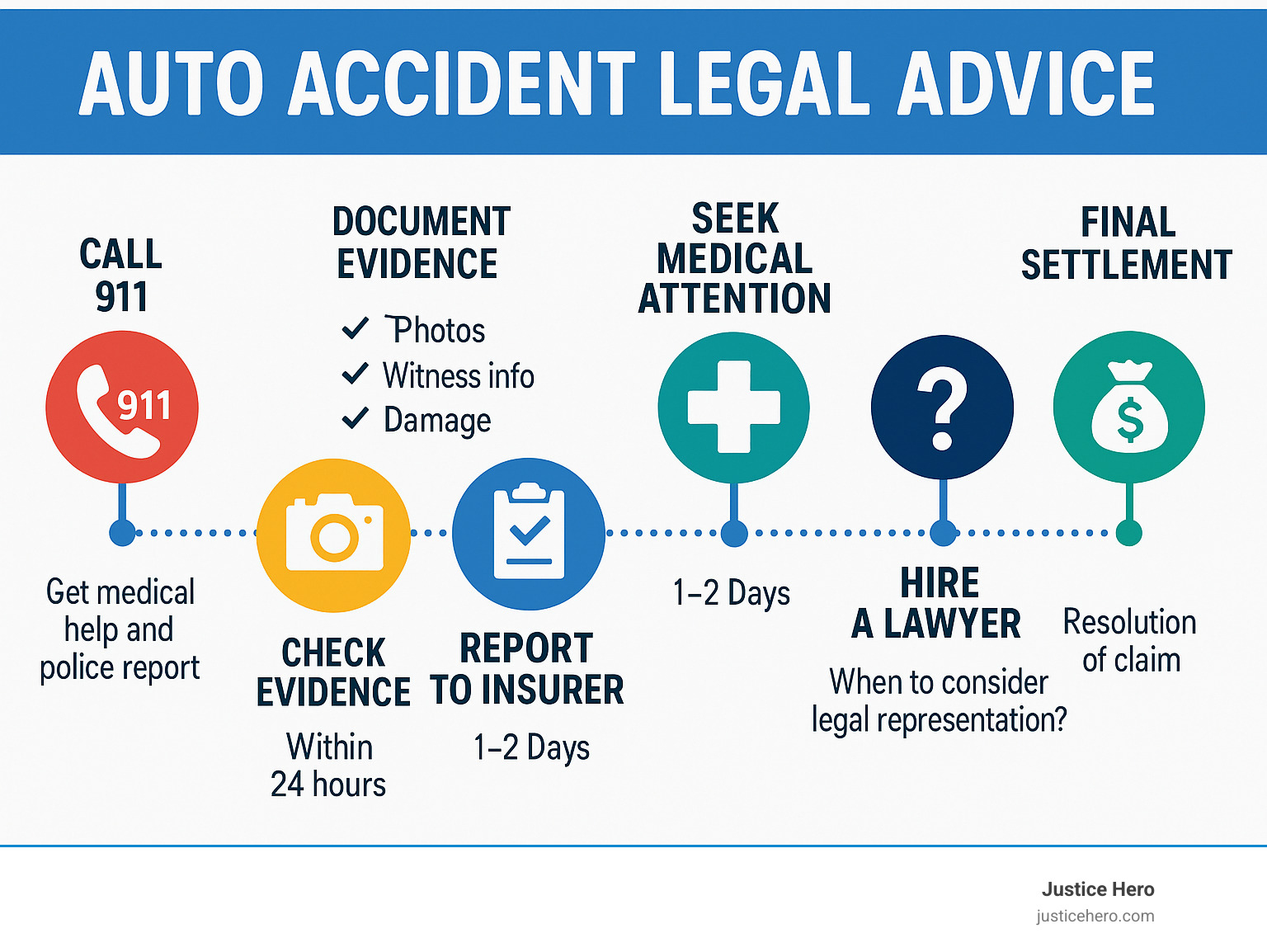
Step-by-step infographic: how to secure a rental car after an accident through insurance - Rental car after accident

Related content about Rental car after accident:

Who Is Responsible for Rental Costs?
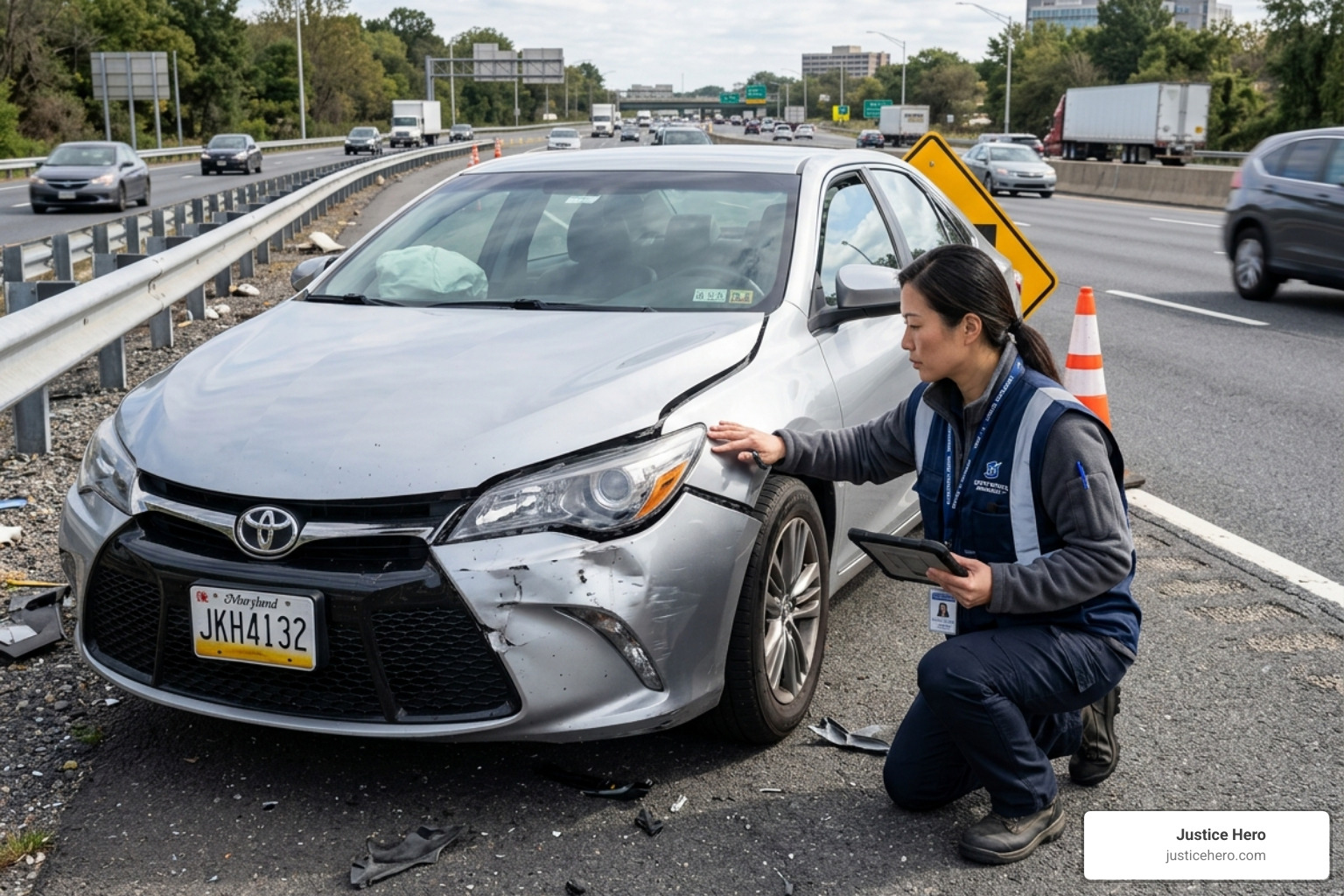
insurance adjuster inspecting a car after an accident - Rental car after accident

When your vehicle is sitting in a body shop, the question of "who pays" usually boils down to liability. In California, the driver who caused the crash is generally responsible for the resulting damages, which include the "loss of use" of your vehicle.

If the other driver is clearly at fault, their liability insurance should technically pick up the tab for your rental car after accident. However, Dealing with Insurance Companies is rarely a walk in the park. The at-fault party's insurer may drag their feet while they "investigate" the claim. They aren't always in a hurry to provide a rental because doing so can be seen as an admission of liability.

This is why many victims choose to file Traffic Accident Personal Injury Claims to ensure all their costs—not just the rental—are covered. While you wait for a third-party claim to process, you might find yourself stuck between paying out of pocket or waiting weeks for an authorization.

Using Your Own Rental Reimbursement Coverage

The most seamless way to get back behind the wheel is through your own policy if you have "Rental Reimbursement Coverage." This is an optional add-on that typically requires you to already carry comprehensive and collision coverage.

The beauty of using your own policy is speed. Your insurer provides the service you pay for regardless of who was at fault initially. They will handle the rental and then seek to get their money back from the at-fault driver's insurance later through a process called subrogation. Understanding these Auto Accident Legalities can save you a lot of frustration. According to Progressive, this coverage is specifically designed for situations where your car is "undrivable" due to a covered loss.

Seeking Payment from the At-Fault Party

If you don't have rental coverage on your own policy, you must rely on the at-fault driver's property damage liability insurance. Under California Accident Laws, the responsible party must compensate you for the loss of use of your vehicle.

However, there are hurdles:

In these cases, a Motor Vehicle Accident Lawsuit Settlement might be the only way to recover those costs if the insurer denies responsibility. Filing an Injury Claim Car Crash often helps put the necessary pressure on insurers to fulfill their obligations.

How to Secure a Rental Car After an Accident

Once the dust has settled, you need to move quickly. The first step is always to ensure there is a police report. This serves as the primary evidence for your Auto Accident Claims.

Next, contact the insurance companies. If you’re using your own coverage, your agent can often set up "direct billing" with a rental agency. As noted by Enterprise Rent-A-Car, direct billing means the insurance company pays the rental agency directly, so you aren't stuck waiting for a reimbursement check.

If you're going through the at-fault driver's insurance, you'll need a claim number and a confirmation from their adjuster that they are accepting liability for the rental. If they haven't accepted liability yet, you may have to pay for the rental yourself and keep the receipts to include in your Accident Settlement Process.

Comparable Vehicle Restrictions for a Rental Car After an Accident

You might be dreaming of an upgrade, but insurance companies generally follow the "like-kind" rule. If you drive a standard Toyota Camry, the insurance company isn't going to pay for a Cadillac Escalade.

According to Enterprise's FAQs, you are typically entitled to a vehicle comparable in size and function to your own. If you drive a minivan because you have four kids, you have a right to a minivan—not a subcompact. However, luxury car exclusions are common; unless you were driving a high-end luxury vehicle, don't expect the insurer to cover the daily rate of one. This concept is similar to a Diminished Value Claim, where the goal is to return you to the financial position you were in before the crash.

Duration of Coverage for a Rental Car After an Accident

Insurance doesn't pay for a rental indefinitely. Coverage is usually limited to a "reasonable repair time." If the body shop says it takes ten days to fix your bumper, the insurance company will pay for ten days. If the shop is backed up and can't start for a month, you might have a fight on your hands regarding who pays for that extra time.

If your car is a "total loss," the rules change. Most insurers will only provide a rental car after accident for a few days (often 3 to 7 days) after they make a settlement offer for your totaled vehicle. They expect you to use that settlement money to buy a replacement immediately. Budget Car Rental notes that once a vehicle is declared a total loss, the clock starts ticking loudly on your rental period. Navigating the Car Accident Lawsuit Process can help if the insurer tries to cut off your rental before you've even received your settlement check.

Policy Limits, Deductibles, and Out-of-Pocket Costs

It is vital to check your "Declaration Page" to see your specific limits. Most rental reimbursement policies have a daily cap (e.g., $30 or $50 per day) and a total maximum (e.g., $900 or $1,500 per claim).

If you choose a car that costs $60 a day but your policy only covers $40, you are responsible for the $20 difference. Additionally, insurance almost never covers:

Understanding Motor Vehicle Accident Laws in California is essential here, as these out-of-pocket costs can sometimes be recovered in a Rear End Accident Lawsuit if the other driver was negligent.

Does Rental Reimbursement Have a Deductible?

In most cases, no. Rental reimbursement itself does not usually have a separate deductible. However, to trigger the rental coverage, you usually have to file a collision or comprehensive claim—and those definitely have deductibles.

If you have a $500 collision deductible, you'll have to pay that toward your car's repairs, but the insurance company will start paying for the rental from dollar one. Always seek Auto Accident Legal Advice if an insurer tries to apply a deductible to your rental costs, as this is often a sign of a Personal Injury Motor Vehicle Lawsuit waiting to happen.

What If the Other Driver Is Uninsured?

This is a nightmare scenario for many. If you are hit by someone without insurance and you don't have rental reimbursement, you might be able to use Uninsured Motorist Property Damage (UMPD) coverage.

If you have neither, you are unfortunately looking at paying out of pocket. You can sue the driver personally, but as the saying goes, "you can't squeeze blood from a turnip." If they don't have insurance, they likely don't have assets to seize. In these cases, some victims look into Settlement Loans to stay afloat while pursuing a Hit and Run Lawsuit or a claim against a Drunk Driver.

Frequently Asked Questions About Post-Accident Rentals

We hear a lot of questions about the "fine print" of rental car after accident logistics. Here are the most common ones we encounter at Justice Hero.

Can I add rental reimbursement coverage after an accident?

The short answer is: No. You cannot buy a fire insurance policy while your house is already on fire. Any changes you make to your policy after an accident will only apply to future losses. If you are currently in a Minor Car Accident Lawsuit, you'll have to rely on the coverage you had at the exact moment of the impact.

Does insurance cover a rental for mechanical breakdowns?

Generally, no. Rental reimbursement is triggered by "covered perils"—usually accidents, theft, or vandalism. If your transmission simply dies because of old age or poor maintenance, your insurance company isn't going to buy you a rental car. These are considered maintenance issues, quite different from the Types of Pain Following an Accident that lead to insurance claims.

What happens if I crash the rental car?

This is the "double-whammy" of bad luck. If you get into an accident while driving your rental car after accident, the rental company will look to you for payment.

As Progressive points out, crashing a rental can affect your insurance rates just like crashing your own car.

Conclusion

Navigating a rental car after accident is about more than just finding a set of wheels; it's about protecting your financial recovery. Whether you are dealing with a stubborn insurance adjuster or trying to understand your own policy limits, you don't have to do it alone.

At Justice Hero, we specialize in simplifying these complex legal hurdles. From ensuring you get a comparable vehicle to fighting for your right to a fair Motor Vehicle Injury Claim, our goal is to help you find the right Motor Vehicle Accident Attorney to advocate for your rights.

If you're in California and struggling with the aftermath of a crash, it's time to Know Your Rights. Don't let an insurance company leave you stranded on the side of the road—literally or financially. Reach out to us today to learn how we can help you secure the justice and the transportation you deserve.

The Price of a Fender Bender and Your Potential Settlement

The Price of a Fender Bender and Your Potential Settlement

What Is a Car Accident Injury Settlement Worth?

A car accident injury settlement is a legally binding agreement where the at-fault party (or their insurer) pays you compensation to resolve your claim — without going to trial. Here's a quick snapshot of what settlements typically look like:

Injury Type Typical Settlement Range
Minor / soft tissue $2,000 – $25,000
Whiplash (moderate to severe) $10,000 – $100,000+
Bone fractures $25,000 – $75,000
Herniated disc $75,000 – $200,000
Traumatic brain injury (TBI) $500,000 – $4,000,000+
Spinal cord / paralysis $1,000,000 – $5,000,000+

The national average settlement is roughly $19,000 to $30,000 — but that number means very little on its own. Your payout depends on your specific injuries, medical costs, lost wages, and who was at fault.

Over 95% of car accident cases settle out of court. That means most people never see a courtroom — they negotiate a number with an insurance company and move on. The problem? Many victims accept early offers that undervalue their claim by 30–60%, according to claims data.

This guide will walk you through how settlements are calculated, what injuries pay the most, and how to avoid leaving money on the table.

I'm Tim Burd, founder of Justice Hero, a legal services company that has helped thousands of people understand their rights and connect with the right attorneys for their car accident injury settlement and other personal injury claims. Having worked closely with legal professionals and injury victims across the country, I've seen how the right information — and the right representation — can dramatically change what someone walks away with.

Car accident injury settlement process infographic showing injury types, average payout ranges, and key timeline steps - car

Simple guide to car accident injury settlement:

What Determines a Car Accident Injury Settlement?

stack of medical bills and legal documents related to a car accident claim - car accident injury settlement

When we look at a car accident injury settlement, we aren't just looking at a random number pulled out of a hat. Insurance adjusters and attorneys use a specific set of variables to determine what a case is worth. While every accident is unique, several core factors act as the "engine" behind the final dollar amount.

First and foremost is the severity of your injuries. A permanent disability will always command a higher value than a temporary bruise. However, even "minor" injuries can lead to significant payouts if they require extensive physical therapy or prevent you from working. This leads us to the concept of a personal injury claim and how it is structured.

Another critical factor is liability clarity. In California, we follow a pure comparative negligence rule. This means if you are found partially at fault, your settlement is reduced by that percentage. If the other driver was 100% at fault and was caught drag racing or driving under the influence, the settlement value often increases because the liability is undeniable.

Insurance policy limits also play a massive role. You could have a million-dollar injury, but if the at-fault driver only carries the California state minimum for bodily injury ($15,000 per person), you may be limited to that amount unless there are other avenues for recovery, such as your own underinsured motorist coverage.

Finally, we have to look at the documentation. Proving lost wages is essential for a fair recovery. If you can’t show exactly how much money you lost while recovering, the insurance company won’t just take your word for it.

Comparing Damages: Economic vs. Non-Economic

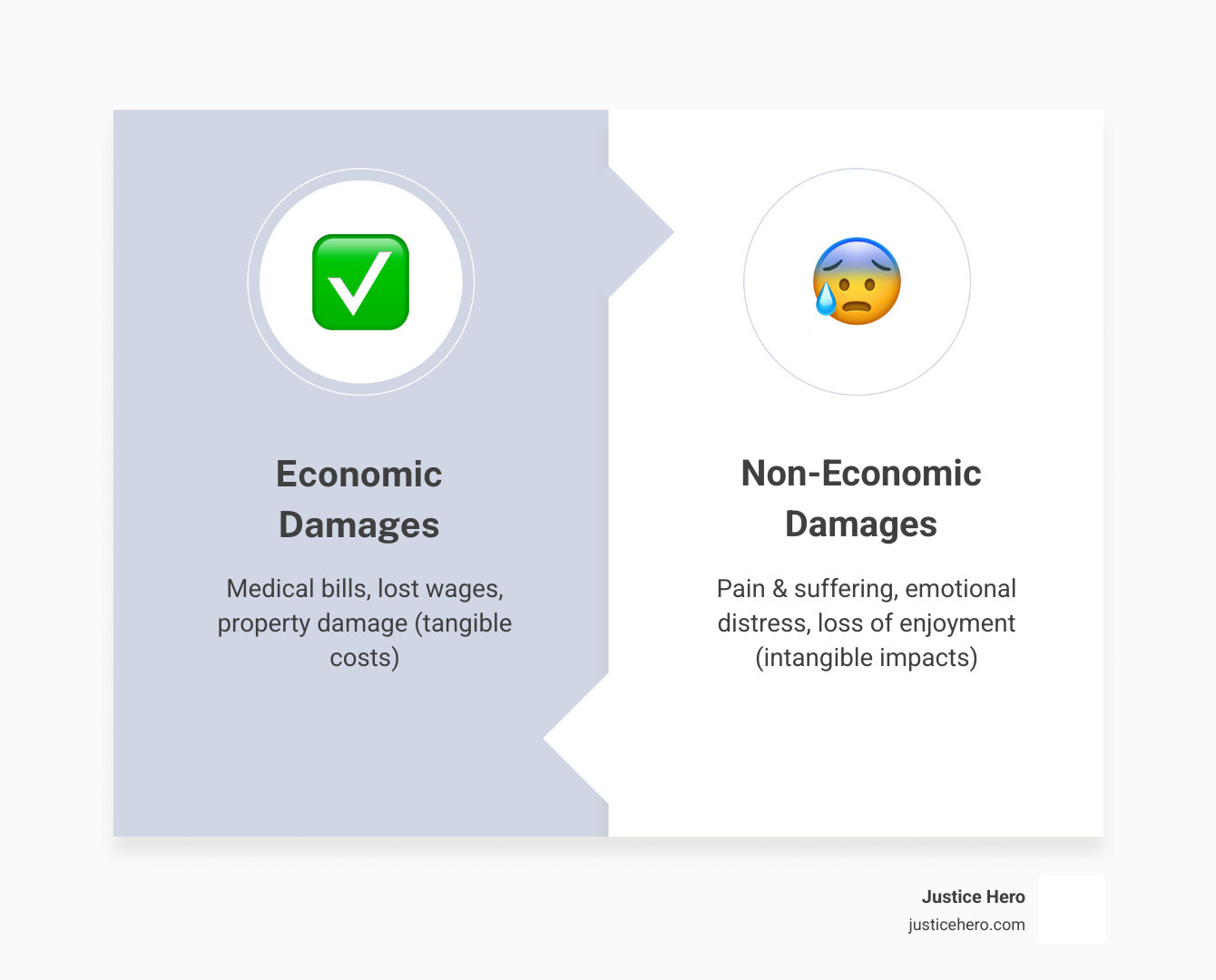
To understand your potential payout, you need to distinguish between the two main types of compensatory damages.

Feature Economic Damages Non-Economic Damages
Definition Quantifiable financial losses. Subjective, non-monetary losses.
Examples Medical bills, lost wages, property damage. Pain and suffering, emotional distress.
Evidence Receipts, invoices, pay stubs. Personal journals, witness testimony.
Calculation Direct addition of costs. Multiplier or Per Diem methods.

Calculating Your Car Accident Injury Settlement

How do insurance companies actually do the math? Most use a Multiplier Method. Here is how it works:

  1. We add up all your economic damages (medical bills + lost wages).
  2. We multiply that total by a number between 1.5 and 5.
  3. A "1.5" multiplier is used for minor, soft-tissue injuries. A "5" or higher is reserved for catastrophic, life-altering injuries.

For example, if you have $20,000 in medical bills and $5,000 in lost wages ($25,000 total) and the adjuster applies a multiplier of 3 for a moderate injury, your estimated settlement would be $75,000.

Some companies also use the Per Diem approach, which assigns a specific dollar value to every day you live in pain from the accident until you reach maximum recovery. Understanding these third-party claims is the first step toward a successful negotiation.

High-Value Injuries and Payout Benchmarks

Not all injuries are created equal in the eyes of the law. "High-value" injuries are those that result in permanent changes to a person’s quality of life, require lifelong medical care, or involve extreme physical pain.

Traumatic Brain Injuries (TBI)

According to CDC research on TBI impact, over 5 million Americans live with a TBI-related disability. In a car accident injury settlement, a TBI can range from a mild concussion to permanent cognitive impairment. Because the brain controls everything from motor skills to personality, these settlements are often the highest, frequently exceeding $500,000 to $4,000,000+.

Spinal Cord Damage and Paralysis

Spinal cord injuries are catastrophic. The Reeve Foundation data on paralysis costs shows that the lifetime costs for a person living with paraplegia or quadriplegia can easily exceed $5 million. When we handle these cases, the settlement must account for home modifications, specialized vehicles, and 24/7 nursing care.

Herniated Discs and Orthopedic Injuries

Herniated discs are perhaps the most common "serious" injury in car accidents. While they may not always require surgery, they often result in chronic pain. Settlements for these typically range from $75,000 to $200,000, though they can go higher if surgery (like a discectomy or fusion) is required.

Other high-value injuries include:

Average Payouts for Specific Injuries

Even if your injury isn't catastrophic, you are still entitled to fair whiplash injury compensation.

The Settlement Process: From Crash to Check

The injury claim process is a marathon, not a sprint. If you try to finish it too fast, you'll likely trip and lose money. Here is the typical step-by-step journey:

  1. Investigation and Evidence Gathering: We collect police reports, witness statements, and photos of the scene.
  2. Medical Treatment: This is the most important step. You must follow your doctor’s orders perfectly. If you skip appointments, the insurance company will argue you weren't actually hurt.
  3. Maximum Medical Improvement (MMI): You should never settle until you reach MMI. This is the point where your condition has stabilized. If you settle before this, you might discover you need a $50,000 surgery next year—and you'll have to pay for it out of your own pocket.
  4. The Demand Letter: Your attorney sends a formal complaint or demand letter to the insurance company. This letter outlines the facts, your injuries, and the specific amount of money we are seeking.
  5. Negotiation: This is the "back and forth." The insurance company will make a lowball offer, and we will counter with evidence. Dealing with insurance companies requires patience and a thick skin.
  6. Mediation or Litigation: If the parties can't agree, we may go to mediation (a neutral third party helps us settle) or file a formal lawsuit.
  7. Finalizing the Settlement: Once an agreement is reached, you sign a release form, and the check is issued.

When to Accept a Car Accident Injury Settlement

Deciding when to sign on the dotted line is a major decision. We always advise clients to consider the MMI impact on their case.

The Risks of Accepting Too Early: Insurance companies love to offer "quick cash" within days of an accident. They might offer you $2,000 plus your medical bills to date. Do not take it. By accepting, you sign away your right to sue if your back starts hurting two weeks later. Early settlements trade speed for value, often sacrificing 30% to 60% of the claim's true worth.

Check our settlement payout guide for more details on timing your acceptance.

In Irvine and throughout California, the legal framework heavily influences your payout.

Comparative Negligence in California

California accident laws utilize a "pure comparative negligence" system. This is actually very friendly to victims. Even if you were 99% at fault for an accident, you could technically still recover 1% of your damages.

For example, if your total damages are $100,000 but a jury finds you were 25% at fault (perhaps you were speeding slightly when someone cut you off), your car accident injury settlement would be reduced to $75,000.

The Role of Policy Limits

Insurance is a "cap" on most settlements. In California, many drivers carry only the minimum. If your damages exceed their limits, we look for other options:

Do You Need an Auto Accident Claim Lawyer?

You aren't legally required to have a lawyer, but the statistics are clear: victims represented by an auto accident claim lawyer receive significantly higher settlements—even after the lawyer's fees are deducted.

How much do they cost? Most personal injury attorneys work on contingency fees. This means:

This system allows everyone, regardless of their bank account balance, to pursue personal injury litigation against giant insurance corporations.

Frequently Asked Questions about Car Accident Settlements

What is the average car accident settlement amount?

While the national average is around $19,000 to $30,000, this includes thousands of minor "fender benders." For cases involving documented injuries like broken bones or disc herniations, the average is much higher, often ranging between $50,000 and $150,000.

Can I get a settlement if I wasn't injured?

If there is no injury, you generally cannot file a "personal injury" claim. However, you can still get a settlement for property damage to repair or replace your vehicle. Some insurance companies may offer a small "nuisance" settlement of $500 to $1,000 to close the file, but without medical treatment, a significant payout is unlikely.

How long does it take to receive settlement funds?

Once you sign the final release form, the insurance company usually sends the check to your attorney within 30 days. Your attorney then pays off any medical liens (bills you owe to doctors) and takes their fee before cutting you a check for the remaining balance. The entire process from crash to check typically takes 4 to 12 months for standard cases and 1 to 2 years for complex or catastrophic injuries.

Conclusion

Navigating a car accident injury settlement is one of the most stressful things a person can go through. Between the physical pain of the injury and the aggressive tactics of insurance adjusters, it’s easy to feel overwhelmed.

At Justice Hero, we believe that every victim deserves to understand the true "price" of their accident. Whether you are dealing with a minor whiplash claim or a life-changing spinal injury, the goal remains the same: ensuring the insurance company pays for the full scope of your loss, not just the bare minimum.

Don't let a "fender bender" ruin your financial future. If you've been hurt, take the time to reach MMI, document every penny you spend, and consult with a professional who can stand up to the insurance companies on your behalf.

Seek justice for your motor vehicle accident today and ensure you get the compensation you truly deserve.

Navigating the Aftermath: Understanding Auto Accident Legalities

Navigating the Aftermath: Understanding Auto Accident Legalities

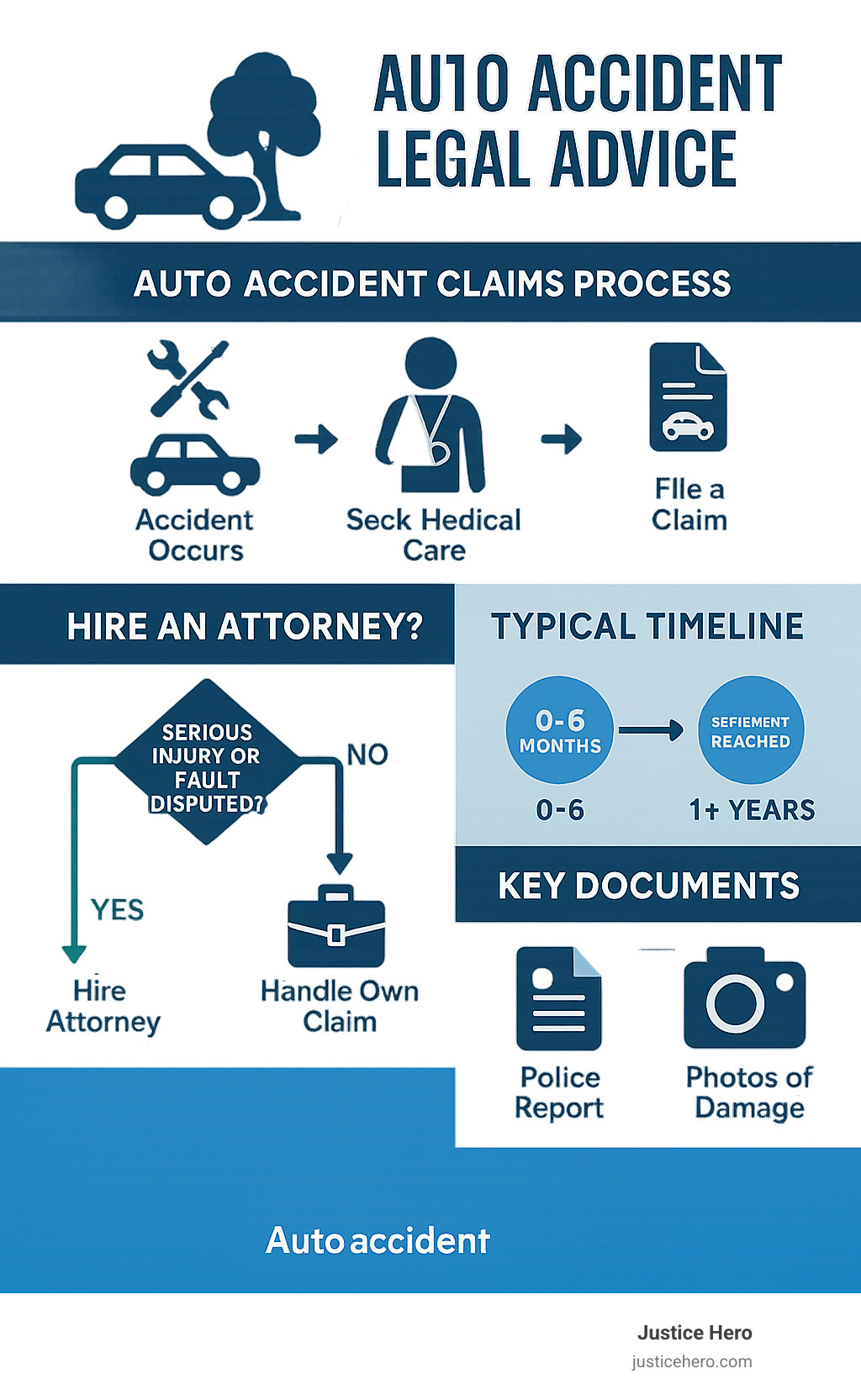
Understanding your auto accident legal rights can make the difference between fair compensation and being left with unpaid bills, lost income, and no recourse.

Here is a quick overview of the key things you need to know:

Topic Key Point
Fault and liability The at-fault driver (or their insurer) is generally responsible for your losses
Statute of limitations In California, you have 2 years from the accident date to file a personal injury lawsuit
Compensation types Medical bills, lost wages, property damage, pain and suffering, and more
When to hire a lawyer Serious injuries, disputed fault, uninsured drivers, or complex crashes
Cost to hire a lawyer Most car accident lawyers work on contingency — no fees unless you win
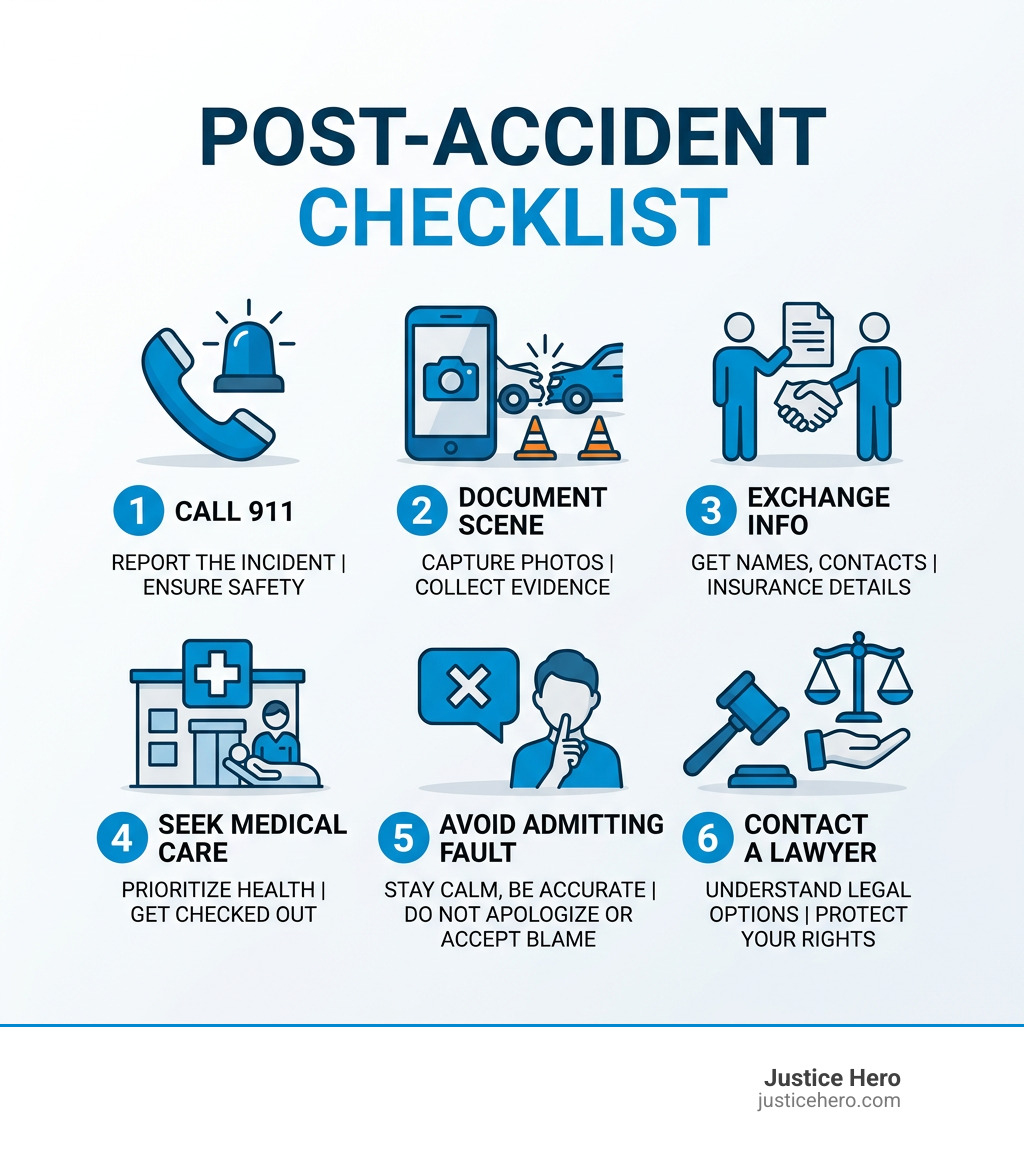
First steps Call 911, document the scene, seek medical care, and do not admit fault

Car accidents happen every day. In 2022 alone, 42,514 people died in car accidents across the United States. In California, nearly 204,000 people were injured in a single year. The physical, emotional, and financial toll is enormous — and most victims don't fully understand their legal rights in the aftermath.

The legal process after a crash can feel overwhelming. Insurance adjusters call quickly. Medical bills pile up. And the clock is already ticking on your right to file a claim.

This guide walks you through everything — from the scene of the crash to the courtroom — in plain language.

I'm Tim Burd, founder of Justice Hero, a legal services company that connects people with the right attorneys for their situation, including auto accident legal cases. Through my work helping thousands of people navigate complex legal claims, I've seen how the right legal guidance can transform outcomes for accident victims.

Post-accident checklist infographic: call 911, document scene, exchange info, seek medical care, avoid admitting fault

Auto accident legal vocab explained:

Immediate Steps and Critical Mistakes to Avoid

driver documenting vehicle damage - auto accident legal

The moments following a collision are chaotic, but they are also the most critical for your future auto accident legal claim. Your first priority must always be safety. If possible, move your vehicle to a safe area to avoid further collisions, but never leave the scene entirely. Leaving the scene of an accident involving injury or death can lead to hit-and-run charges, which in California can carry fines up to $10,000 and a year in jail according to California Vehicle Code 20001 VC.

Once you are safe, call 911. A police report is an objective piece of evidence that insurance companies rely on heavily. While waiting for officers, begin your own evidence collection. Use your phone to take photos of:

Don't forget to gather witness contact information. Independent bystanders often provide the most credible accounts of what happened. For a detailed roadmap of these first moments, we recommend reviewing the California Department of Insurance Guide.

Avoiding the Admission of Guilt

One of the most common mistakes victims make is an accidental admission of guilt. In the heat of the moment, it is natural to say "I'm so sorry" or "I didn't see you." However, insurance adjusters can twist these polite gestures into a legal confession of fault.

Stick to the facts when speaking with the police or the other driver. Avoid discussing the specifics of the crash on social media, as insurance companies actively monitor these platforms to find evidence that contradicts your injury claims. If an insurance adjuster asks for a recorded statement, politely decline until you have sought Car Accident Legal Advice. They are trained to ask "trick" questions that can minimize your settlement.

Navigating a claim on your own is like trying to perform surgery after watching a YouTube video—it’s risky and usually ends in pain. An auto accident legal representative does much more than just "file paperwork." They act as your shield and your investigator.

Lawyers handle the heavy lifting by:

The FTC Guide to hiring a car accident lawyer emphasizes that having professional counsel can significantly increase the settlement amount compared to self-representation. If you are unsure where to start, an Auto Accident Claim Lawyer can evaluate your case for free.

Not every fender bender requires a high-powered legal team. However, you should definitely seek Auto Accident Legal Advice if:

  1. Serious injuries occurred: If you have broken bones, a head injury, or required hospitalization.
  2. Liability is disputed: If the other driver is blaming you for the crash.
  3. Uninsured motorists are involved: An estimated 20% of California drivers have no insurance.
  4. Complex crashes: Accidents involving commercial trucks, rideshare drivers (Uber/Lyft), or government vehicles require specialized knowledge.

Understanding Attorney Fees and Contingency Models

Many people hesitate to call a Motor Vehicle Accident Attorney because they fear the cost. The good news is that almost all personal injury lawyers work on a contingency fee basis.

This means:

This model allows everyone, regardless of their bank account balance, to have access to top-tier legal representation.

Proving Liability and Common Causes of Collisions

To win a case, we must prove that the other driver was "negligent." This means they breached their "duty of care" to drive safely. Common causes of negligence include speeding, failing to yield, and distracted driving.

One of the most severe forms of negligence is impaired driving. California Vehicle Code § 23152 makes it illegal to drive under the influence of alcohol or drugs. If your accident involved a drunk driver, you may be eligible to file a Drunk Driving Accident Lawsuit, which sometimes allows for higher damages to punish the offender.

Determining Fault in Complex Scenarios

Fault isn't always black and white. Sometimes, multiple parties share the blame. To untangle these California Accident Laws, legal teams use:

The Impact of Comparative Negligence

California follows a "pure comparative negligence" system. This means that even if you were partially at fault for the accident, you can still recover damages. However, your compensation will be reduced by your percentage of fault.

For example, if a jury decides your total damages are $100,000 but finds you were 20% at fault (perhaps for speeding slightly), you would receive $80,000. This is different from some other states where being even 1% at fault can bar you from recovery. Understanding these nuances is vital when filing an Auto Accident Lawsuit.

Pursuing Compensation for Injuries and Damages

When we talk about "damages" in an auto accident legal context, we are referring to the money required to make you "whole" again. These are generally split into two categories:

Economic Damages (Tangible) Non-Economic Damages (Intangible)
Hospital and doctor bills Pain and suffering
Future medical treatment Emotional distress/PTSD
Lost wages and bonuses Loss of enjoyment of life
Property damage (car repairs) Loss of consortium (relationship impact)

For a deeper look at how physical pain translates to legal claims, see our guide on Motor Vehicle Injuries: Types of Pain Following an Accident.

Common Car Accident Injuries and Long-Term Effects

Injuries from a car crash aren't always immediately obvious. The adrenaline rush of a crash can mask pain for hours or even days. Common injuries include:

It is essential to document every symptom. An Injury Claim Car Crash is only as strong as the medical records backing it up.

Seeking Non-Economic and Punitive Damages

While bills are easy to calculate, how do you put a price on chronic back pain or the inability to hold your child? This is where a skilled lawyer earns their keep. They use "multipliers" or "per diem" methods to argue for a fair Bodily Injury Settlement.

In rare cases involving "gross negligence"—such as a driver fleeing the police or a commercial trucking company ignoring safety logs—you may pursue punitive damages. These aren't meant to compensate you, but rather to punish the defendant and deter others from similar behavior.

The Car Accident Lawsuit Process is a marathon, not a sprint. It typically follows these steps:

  1. Filing the Complaint: The official legal document starting the lawsuit.
  2. Discovery: Both sides exchange evidence, take depositions (sworn statements), and interview experts.
  3. Mediation: A neutral third party tries to help the sides reach a settlement before trial.
  4. Trial: If no settlement is reached, a judge or jury decides the outcome.

Despite the national statistics showing over 42,514 fatalities annually, most cases actually settle before they ever reach a courtroom.

You cannot wait forever to take action. Under California Accident Laws, the general statute of limitations for a personal injury claim is two years from the date of the accident.

However, there are major exceptions:

Missing these deadlines means you lose your right to compensation forever.

Dealing with Insurance Adjusters and Settlements

Insurance adjusters are not your friends. Their job is to settle your claim for the lowest amount possible. They may use a process called subrogation to recover costs from other insurers, but your focus should be on the Accident Settlement Process.

Never sign a "final release" until you are certain your medical treatment is complete. Once you sign, you cannot go back and ask for more money if your injury worsens later.

Frequently Asked Questions about Auto Accident Law

How much does it cost to hire a car accident lawyer?

As mentioned, most work on a contingency fee basis. You pay nothing out of pocket. The lawyer takes a percentage of the final settlement. If they don't win, you don't pay.

What if the other driver doesn't have insurance?

In California, about 20% of drivers are uninsured. If you have "Uninsured Motorist" (UM) coverage on your own policy, your insurance company "steps into the shoes" of the at-fault driver. You would then file a claim against your own policy to cover your injuries.

How long will it take to resolve my car accident claim?

A simple claim with clear liability might settle in a few months. However, complex cases involving serious injuries or litigation can take 12 to 24 months. It’s important not to rush the process; you only get one chance at a settlement.

Conclusion

At Justice Hero, we believe that no one should have to face the aftermath of a crash alone. Navigating auto accident legal hurdles requires patience, evidence, and expert guidance. Whether you are dealing with a minor injury or a life-altering collision, understanding your rights is the first step toward recovery.

If you are in Irvine or anywhere in California and need help finding the right path forward, we are here to empower you. For More info about mass tort services or to get a free evaluation of your motor vehicle claim, reach out to us today. Justice isn't just a name—it's what we fight for every day.

Your Accident Payout A Quick Guide to Settlement Calculation

Your Accident Payout A Quick Guide to Settlement Calculation

What Your Accident Payout Is Actually Worth (And How to Estimate It)

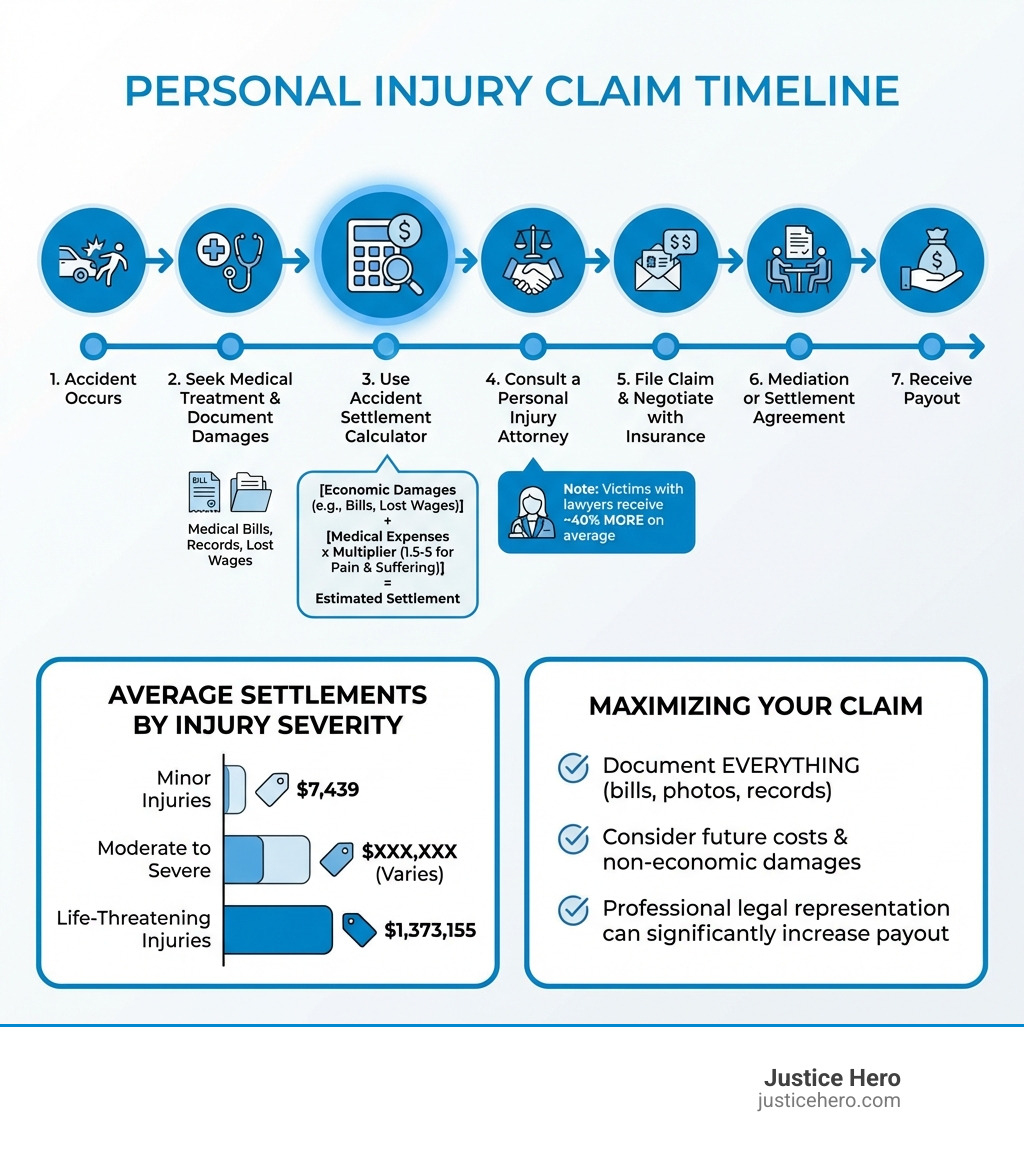
An accident settlement calculator is a tool that estimates what your injury claim may be worth before you negotiate with an insurance company. Here's how the basic formula works:

Quick Answer: How Settlement Calculators Work

  1. Add up your economic damages - medical bills, lost wages, property damage, and estimated future costs
  2. Multiply your medical expenses by a factor of 1.5 to 5 (based on injury severity) to estimate pain and suffering
  3. Add both figures together to get your estimated total settlement value
  4. Adjust downward based on your percentage of fault, depending on your state's negligence rules

Example: $20,000 in medical bills + $8,000 property damage + $10,000 lost wages = $38,000 in economic damages. Multiply by 2 for pain and suffering = $76,000 estimated total.

This number is a starting point for negotiation, not a guarantee. Insurance adjusters, attorneys, and courts all weigh factors that no online tool can fully capture.

That said, understanding the formula gives you real leverage. Over 95% of accident claims settle out of court, and knowing your numbers before you walk into that conversation matters.

I'm Tim Burd, founder of Justice Hero and Mass Tort Strategies, where my team has helped thousands of injury victims understand their legal rights and connect with the right representation - including navigating the very accident settlement calculators and insurance formulas covered in this guide. In the sections ahead, I'll break down exactly how these tools work, where they fall short, and how to use them to your advantage.

Infographic showing the personal injury claim timeline: step 1 accident occurs, step 2 seek medical treatment and document damages, step 3 use an accident settlement calculator to estimate economic and non-economic damages using the multiplier method, step 4 consult a personal injury attorney, step 5 file claim and negotiate with insurance, step 6 mediation or settlement agreement, step 7 receive payout; includes callout boxes showing average settlements by injury severity ranging from $7,439 for minor injuries to $1,373,155 for life-threatening injuries, and a note that victims with lawyers receive 40% more on average - Accident settlement calculator infographic

Accident settlement calculator further reading:

How an Accident Settlement Calculator Estimates Your Claim Value

When we look at an accident settlement calculator, we aren't just looking at a random number generator. These tools are designed to mimic the "mental math" that insurance adjusters and personal injury lawyers use every day. To get an accurate estimate, the calculator divides your losses into two primary buckets: economic and non-economic damages.

Most insurance companies use proprietary software, like Colossus, to process claims. These programs look at data points—your zip code, the type of injury, and the duration of treatment—to spit out a settlement range. By using a calculator yourself, you are essentially trying to see the cards the insurance company is holding.

Understanding the accident settlement process is the first step toward ensuring you aren't leaving money on the table.

Understanding the Injury Settlement Formula

The core of any accident settlement calculator is the "Special Damages" or economic damages. These are the quantifiable losses that have a clear paper trail. We’re talking about:

The Role of Special vs. General Damages

While special damages are tangible, "General Damages" are intangible. This is where the bodily injury settlement gets complicated. General damages cover:

Because you can't print a receipt for "misery," calculators use a multiplier to turn these feelings into a dollar amount.

The Multiplier Method: Calculating Pain and Suffering

The multiplier method is the industry standard for valuing non-economic damages. We take your total medical bills (the "specials") and multiply them by a number, typically between 1.5 and 5.

Choosing the Right Multiplier for Your Accident Settlement Calculator

How do we decide if your case is a "2" or a "5"? It comes down to medical intensity and life impact. If you had surgery, your multiplier goes up. If you just had three chiropractic visits, it stays low.

There is also something called "nuisance value." In very minor cases where there is little to no injury, an insurance company might offer a flat $1,000 just to make the claim go away. However, if your injury interferes with your daily life—like being unable to lift your toddler or drive to the store—you should push for a higher multiplier.

How Future Costs Factor Into the Equation

A common mistake people make when using an accident settlement calculator is only looking at the bills they have right now. If your doctor says you’ll need physical therapy for the next year, or a knee replacement in five years, those costs must be included.

We also have to consider the "Loss of Earning Capacity." If a carpenter loses an arm, they haven't just lost current wages; they’ve lost the ability to earn a living in their trade forever. Factoring in inflation and life expectancy is a vital part of the car accident lawsuit process.

How Fault and State Laws Impact Your Final Payout

You could have $100,000 in damages, but if you were partially at fault for the accident, you won't see the full amount. This is where state laws come into play. Since Justice Hero operates in California, we focus heavily on "Pure Comparative Negligence."

Adjusting Estimates for Comparative Negligence

In California, your settlement is reduced by your percentage of fault.

The beauty of pure comparative fault is that even if you were 99% at fault, you could technically still recover 1% of your damages. This is vastly different from "Contributory Negligence" states (like Maryland), where being even 1% at fault bars you from recovering anything.

Navigating these auto accident claims requires a deep understanding of how liability is disputed.

Impact of State-Specific Statutes and Caps

In California, the Statute of Limitations for personal injury is generally two years from the date of the accident. If you miss this window, your claim value drops to zero instantly.

California also has specific rules regarding "uninsured" drivers. Under Proposition 213, if you were the driver of a vehicle and didn't have insurance at the time of the crash, you generally cannot recover "non-economic" damages (pain and suffering), even if the other person hit you! This is why a simple online tool can never replace the injury claim process complete guide.

We love a good accident settlement calculator, but they have limits. Statistics show that victims with lawyers get about 40 percent more money than those who go it alone. Why? Because we know how to fight the insurance company's software.

Insurance adjusters use tools to devalue your claim. They might argue that your medical treatment was "excessive" or that a pre-existing condition caused your pain. An attorney brings in expert testimony to shut those arguments down.

Dealing with insurance companies is like playing chess against a computer—you need a grandmaster on your side.

When to Move Beyond an Accident Settlement Calculator

If your case involves any of the following, a calculator is likely to give you a "lowball" estimate:

Mediation is about 90% successful in resolving personal injury claims without a trial. During mediation, your attorney uses "negotiation leverage." They show the insurance company that they are ready to go to trial, which often forces a higher settlement offer.

If you are struggling financially while waiting for your case to resolve, you might even look into motor vehicle accident lawsuit settlement loans to keep your head above water.

Frequently Asked Questions about Accident Settlements

How long does the settlement process typically take?

Most settlements take between 6 and 18 months. If you settle too quickly, you might miss "latent" injuries—pain that doesn't show up until weeks after the crash. Patience usually leads to a higher payout.

Can I use a calculator for a minor rear-end collision?

Yes, an accident settlement calculator is actually most accurate for minor to moderate claims. For a simple "fender bender" with a few weeks of soreness, the 1.5x multiplier is a very reliable guide.

What happens if the settlement offer is lower than the calculator estimate?

This is common. Insurance companies start low. You should respond with a demand letter that highlights your "Special Damages" and justifies your multiplier. If they won't budge, that's the signal to stop using the calculator and start talking to a lawyer.

Conclusion

At Justice Hero, we believe in legal empowerment. An accident settlement calculator is a fantastic way to get your bearings after a traumatic event, but it's just the beginning of your journey toward justice. Whether you are dealing with a minor scratch or a life-changing collision in Irvine or anywhere across California, maximizing your compensation requires a mix of data, documentation, and dedicated advocacy.

Don't let an insurance company tell you what your life is worth based on a generic algorithm. Take the first step toward a fair payout today.

Contact a Motor Vehicle Accident Attorney

Motor Vehicle Injuries: Types of Pain Following an Accident

Pain After Car Accident: Crucial 2026 Guide

Understanding the Hidden Reality of Post-Collision Injuries

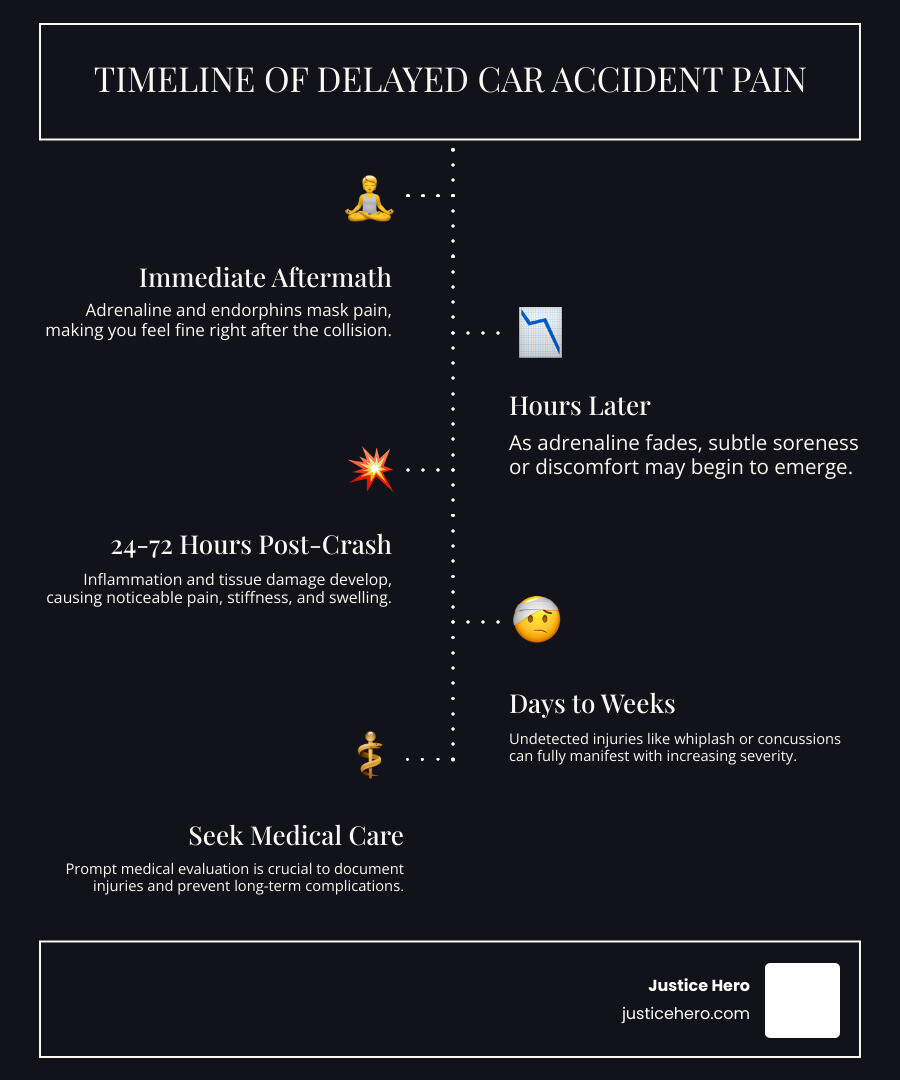
Pain after car accident is often delayed, meaning you might feel fine immediately after a crash but develop symptoms hours, days, or even weeks later. This happens because adrenaline and endorphins mask pain during the initial trauma, while inflammation and tissue damage gradually worsen over time.

Key facts about delayed pain:

More than three million people are injured yearly in motor vehicle accidents nationwide. What many don't realize is that feeling "fine" right after a crash doesn't mean you're uninjured. Your body's natural stress response can hide serious damage that only becomes apparent as inflammation develops and adrenaline fades.

For most people, mild to moderate pain lasts less than six to eight weeks. However, 70% of people are back at work within eight weeks, suggesting that with proper medical attention and treatment, recovery is achievable for the majority of accident victims.

The challenge isn't just physical—it's also about understanding your rights and options when injuries appear days or weeks after the incident. Insurance companies may question whether delayed symptoms are truly related to the accident, making documentation and prompt medical evaluation critical.

As Tim Burd, founder of Justice Hero and Mass Tort Strategies, I've helped connect thousands of people experiencing pain after car accident with the legal resources they need to understand their rights and pursue fair compensation. Through our work with over 50 team members in Southern California, we've seen how delayed symptoms can complicate both recovery and legal claims.

infographic showing timeline of delayed pain symptoms after car accident - pain after car accident infographic infographic-line-5-steps-dark

Pain after car accident terms at a glance:

Why Pain After a Car Accident Is Often Delayed

It's a perplexing phenomenon: you've just been involved in a car accident, the vehicles are damaged, but you, miraculously, feel okay. You might even walk away from the scene without a scratch, only to wake up the next day—or even days later—in agonizing pain after car accident. This delayed onset of symptoms is far more common than you might think, and it's rooted in our body's incredible, yet sometimes deceptive, survival mechanisms.

The primary culprits behind this delay are the body's natural stress response, specifically the rush of adrenaline and endorphins, and the subsequent inflammatory process that unfolds in the injured tissues. These factors work in tandem to mask initial injury, allowing you to function in the immediate aftermath of a traumatic event.

The Body's Immediate Response to Trauma

When a car crash occurs, your body perceives it as a severe threat. In response, it floods your system with stress hormones like adrenaline (epinephrine). This "fight-or-flight" response is a powerful survival tool. Adrenaline rapidly increases your heart rate, tenses your muscles, and heightens your overall alertness. Crucially, it also acts as a natural painkiller. This surge of adrenaline can temporarily numb pain, allowing you to focus on the immediate danger rather than the physical damage you might have sustained.

Coupled with adrenaline, your brain also releases endorphins, which are natural opioids that further contribute to pain suppression. These powerful chemicals can create a temporary sense of euphoria or detachment, further masking the true extent of any injuries. In this "survival mode," your brain prioritizes critical functions—like assessing your surroundings and ensuring your safety—over registering minor aches and pains. This psychological numbing and physiological pain signal suppression mean that even significant injuries might not present with immediate symptoms. For instance, whiplash injuries may not develop pain for up to 12 hours after an accident, and muscle strain effects might not be felt for days.

How the Inflammatory Process Creates Pain

Once the immediate danger has passed and the adrenaline begins to subside, your body shifts its focus to healing. This is where the inflammatory response comes into play, and it's often when delayed pain after car accident begins to surface.

illustrating the stages of inflammation in soft tissue - pain after car accident

Inflammation is a natural and necessary part of the healing process. When tissues are damaged, your body initiates a cellular response to repair them. This involves the release of various chemicals, such as histamine, bradykinin, and prostaglandins, which signal the immune system to send help to the injured area. These chemicals cause local blood vessels to dilate, leading to increased blood flow, redness, and warmth.

More significantly, this increased blood flow also leads to fluid accumulation in the injured tissues, resulting in swelling (edema). This swelling, in turn, can put pressure on surrounding nerves, which then send pain signals to your brain. Micro-tears in muscles, tendons, and ligaments—common in car accidents—might not hurt much at first, but as inflammation sets in, the gradual onset of soreness and stiffness becomes unavoidable. This process can take hours or even days to fully manifest, explaining why you might feel fine at the scene only to wake up with significant discomfort later.

Common Injuries That Cause Delayed Symptoms

Car accidents can inflict a wide array of injuries, many of which are not immediately obvious. These "hidden injuries" can cause delayed pain after car accident and, if left untreated, can lead to chronic issues and long-term disability. According to the National Highway Traffic Safety Administration (NHTSA), more than three million people are injured yearly in motor vehicle accidents nationwide. The different injuries resulting from a car accident, as detailed in overviews from the CDC, can be as varied as the individual circumstances of each collision.

We often see three broad categories of physical injuries: impact injuries (when an occupant strikes part of the vehicle's interior), penetrating injuries (from loose objects), and hidden injuries (pain appearing days or months later). It's these hidden injuries that often cause the most confusion and concern due to their delayed presentation.

For more information on navigating the aftermath of an injury, explore our guide on filing a Motor Vehicle Injury Claim.

Whiplash and Neck Injuries

Whiplash is perhaps the most classic example of an injury that causes delayed pain after car accident. It typically occurs in rear-end collisions but can happen in any crash where the head is suddenly and forcefully thrown forward and backward. This rapid, uncontrolled movement can strain the muscles, ligaments, and tendons in the neck.

diagram showing the mechanics of whiplash - pain after car accident

Symptoms might not appear for hours, but when they do, they can include:

The Mayo Clinic notes that whiplash can occur even in minor crashes and may cause upper back pain and other symptoms. If you're experiencing these symptoms, understanding your rights to Whiplash Injury Compensation is crucial.

Concussions and Traumatic Brain Injuries (TBI)

A concussion is a mild form of traumatic brain injury (TBI) that results from a sudden impact or jolt to the head, causing the brain to move rapidly inside the skull. While a severe TBI might cause immediate unconsciousness, concussions and milder TBIs often present with delayed symptoms. According to the CDC, vehicle crashes are a leading cause of TBI-related hospitalizations, second only to falls.

Symptoms of a concussion or TBI can include:

More serious TBIs can lead to symptoms that appear weeks later, emphasizing the need for vigilance even if you initially feel fine.

Back and Spinal Cord Injuries

The forces involved in a car accident can place immense stress on the spine, leading to a variety of injuries that may cause delayed pain after car accident. These injuries can range from soft tissue strains to more severe damage involving the vertebrae and spinal cord.

Common back and spinal injuries include:

Untreated back injuries can lead to long-term consequences such as spinal stenosis, radiculopathy, and chronic pain. If you've sustained a back injury, understanding your legal options can be an important part of your recovery, as detailed in our guide on Personal Injury Lawsuit.

Internal Bleeding and Organ Damage

Perhaps the most dangerous type of delayed injury is internal bleeding or organ damage, as these can be life-threatening and show minimal external signs. The force of impact, particularly from seatbelts, can cause blunt force trauma to internal organs.

Symptoms to watch for include:

These symptoms can develop hours or even days after the accident. For example, a headache can signal a potentially serious problem, such as a blood clot in the brain, an injury to the neck or head, or a concussion. Any suspicion of internal injuries warrants immediate medical attention.

What to Do Immediately After a Crash (Even If You Feel Fine)

Given the potential for delayed and serious injuries, the steps you take immediately after a car accident are critical, even if you don't feel any pain after car accident. Your actions can significantly impact your health, recovery, and any potential legal claims.

  1. Seek Medical Evaluation: This is paramount. Even if you feel fine, get checked by a doctor within 24-48 hours. A post-crash rush of adrenaline can mask serious injuries. Early diagnosis is the most effective way to start car accident pain treatment and prevent long-term complications. Prompt medical care is also important for insurance purposes, as many policies have strict deadlines for initial treatment.
  2. Document Everything: Take photos of the accident scene, vehicle damage, and any visible injuries. Keep detailed records of all medical visits, treatments, and prescriptions. Document how you feel, what activities increase your pain, and how often it occurs.
  3. Notify Your Insurance Company: Report the accident to your insurer promptly. However, stick to the facts and avoid speculating about fault or the extent of your injuries.
  4. Avoid Immediate Settlements: Do not sign any releases or accept a settlement offer from an insurance company until you have been thoroughly evaluated by a medical professional and consulted with a legal expert. Delayed injuries can mean the true cost of your accident isn't immediately apparent.
  5. Monitor for Symptoms: Be vigilant for any changes in your physical or mental state in the days and weeks following the crash.

Understanding these steps can be crucial for a successful Personal Injury Claim.

Signs That Delayed Pain Indicates a Serious Injury

While some soreness is normal after any traumatic event, certain red-flag symptoms indicate that your delayed pain after car accident might be a sign of a more serious, potentially life-threatening injury. Do not ignore these signs; seek emergency medical care immediately.

The Importance of a Medical Examination

A comprehensive medical examination after a car accident serves multiple vital purposes. Firstly, it establishes a baseline of your health immediately following the incident, which is crucial for identifying any delayed symptoms as they emerge. Secondly, it allows medical professionals to rule out serious, hidden injuries that might not be immediately apparent, such as internal bleeding or a mild traumatic brain injury.

Thirdly, and perhaps most importantly for legal purposes, a medical examination creates a formal medical record. This documentation is essential for connecting any injuries, including those with delayed onset, directly to the car accident. Without this official record, it can be challenging to prove to insurance companies or in court that your delayed pain after car accident is a direct result of the collision. This medical evidence forms the backbone of any potential Injury Claim Car Crash and helps ensure you receive fair compensation for your medical expenses and suffering.

Treatment and Recovery from Car Accident Pain

Once your injuries have been diagnosed, the journey to recovery begins. Treatment for pain after car accident is often multifaceted, involving a combination of medical interventions, therapeutic approaches, and psychological support. The goal is not just to alleviate pain but to restore function, prevent chronic conditions, and support your overall well-being.

Recovery is a personal journey, and there is no single "right" way to respond to a car crash. For most people, mild to moderate pain usually lasts for less than six to eight weeks. Early and consistent treatment is key to preventing acute pain from becoming chronic.

Medical and Therapeutic Treatments

Treatment plans are custom to the specific type and severity of your injuries. Here's a look at common approaches:

Injury Type Common Treatments
Whiplash NSAIDs (Nonsteroidal Anti-inflammatory Drugs) like ibuprofen to reduce pain and inflammation; Muscle relaxants for spasms; Physical therapy (stretching, strengthening exercises, manual therapy); Corticosteroid injections for severe pain; Massage therapy to relieve muscle tension.
Herniated Disc NSAIDs; Physical therapy (core strengthening, posture correction); Corticosteroid injections (epidural injections); Surgery in severe cases; Massage therapy; Chiropractic care for spinal alignment.
Concussion/TBI Rest (physical and cognitive); Medications for headaches, nausea, or dizziness; Physical therapy for balance issues; Occupational therapy for cognitive challenges; Counseling for mood changes.
Soft Tissue Injuries RICE method (Rest, Ice, Compression, Elevation) initially; NSAIDs; Physical therapy (gentle movement, stretching, strengthening); Massage therapy.

The Role of Psychological Factors in Recovery

The impact of a car accident extends beyond physical injuries. The emotional and psychological toll can significantly influence your perception of pain after car accident and your overall recovery. Physical pain and mental health are deeply connected; one can worsen the other, creating a cycle that slows recovery.

Common psychological responses include:

Addressing these emotional wounds is critical for a holistic recovery. Support from friends and family, Cognitive-Behavioral Therapy (CBT), and gentle exercise can be highly effective. Professional counseling can help you process the trauma, manage anxiety, and develop coping strategies, a fact supported by scientific research on the psychological impact of accidents.

Frequently Asked Questions about Pain After a Car Accident

We understand that navigating the aftermath of a car accident, especially when pain after car accident is delayed, can be confusing and overwhelming. Here are some answers to commonly asked questions.

How long can pain from a car accident last?

The duration of pain after car accident varies greatly depending on the severity and type of injury, as well as individual factors. For most people, mild to moderate pain is usually lasts for less than six to eight weeks. This is considered acute pain. With proper medical care and adherence to treatment, many individuals experience significant improvement within this timeframe. After a car crash, 70% of people are back at work within eight weeks.

However, some injuries can lead to chronic pain, defined as pain lasting for more than three months. Factors influencing the duration of pain include:

If your pain persists beyond a few weeks or worsens, it's a sign that you need further medical evaluation to prevent long-term or permanent pain.

Can I still file a claim if my pain was delayed?

Yes, you can still file a claim even if your pain after car accident was delayed, but it can be more complex. Insurance companies may argue that delayed symptoms are not directly related to the accident. This is why prompt medical evaluation, even when you feel fine, is so critical.

Once symptoms appear, no matter how delayed, it is imperative to seek medical attention immediately. This creates a clear medical record that links your injuries to the accident. Without this documentation, proving causation can be challenging.

It's also important to be aware of the statute of limitations, which is the legal deadline for filing a personal injury lawsuit. This timeframe varies, but it typically starts from the date of the accident or when an injury is finded. Consulting with a Motor Vehicle Accident Attorney is highly recommended. An experienced attorney can help investigate your case, gather necessary medical evidence, negotiate with insurance companies, and file a lawsuit if necessary to ensure you receive fair compensation for all your injuries, including those with delayed onset.

What are the first steps for at-home pain relief?

While professional medical care is essential, there are several steps you can take at home to manage pain after car accident and support your recovery, especially in the initial days. Always consult your doctor before starting any new home treatments.

  1. RICE Method (Rest, Ice, Compression, Elevation): For the first 48-72 hours after an injury, this method is highly effective for reducing inflammation and pain.
    • Rest: Avoid activities that aggravate your pain.
    • Ice: Apply ice packs for 15-20 minutes every 2-3 hours to the injured area to reduce swelling and numb pain.
    • Compression: Use a soft bandage to gently compress the area, helping to reduce swelling.
    • Elevation: Keep the injured area liftd above your heart if possible.
  2. Gentle Stretching: After the acute phase (the first few days) and with your doctor's approval, gentle stretching can help prevent stiffness and improve circulation. Do not push into pain.
  3. Avoiding Strenuous Activity: Listen to your body. Avoid heavy lifting, twisting, or any activities that worsen your symptoms. Pushing too hard, too soon, is a common mistake that can lead to re-injury and chronic problems.
  4. Over-the-Counter (OTC) Pain Relievers: Medications like ibuprofen or acetaminophen can help manage mild to moderate pain and reduce inflammation. Always follow dosage instructions and consult your doctor, especially if you are taking other medications or have underlying health conditions.
  5. Stay Hydrated and Eat Well: A nutrient-rich diet and adequate hydration support your body's natural healing processes.

Conclusion

The experience of pain after car accident is complex, often unfolding long after the immediate shock of the collision has faded. The body's incredible ability to mask pain through adrenaline and endorphins, coupled with the gradual onset of inflammation, means that feeling "fine" at the scene is never a guarantee of being uninjured. Ignoring delayed symptoms can lead to chronic pain, long-term disability, and complications in any potential legal claims.

We emphasize the importance of proactive steps: seek immediate medical evaluation, even if you feel no pain; carefully document all symptoms and medical care; and understand that your actions in the aftermath are crucial for both your health and your legal protection.

Empowering yourself with knowledge is a critical part of recovery. Understanding your rights and the potential complexities of delayed injuries can help you steer the medical and legal systems effectively. At Justice Hero, we provide comprehensive resources to help you steer the Car Accident Lawsuit Process, ensuring you have the information and support needed to pursue justice and fair compensation for your injuries. Don't let delayed pain become delayed justice.

Don't Get Lost in Translation: Your Guide to Insurance Company Communication

Dealing with insurance companies: Your 5-Step Win

Why Clear Communication with Your Insurer Matters After a Loss

Dealing with insurance companies after a loss can be a maze of paperwork and jargon. Effective communication is key to protecting your rights and getting a fair settlement.

Quick Guide to Dealing with Insurance Companies:

  1. Report your claim promptly - Contact your insurer as soon as possible after a loss.
  2. Document everything - Take photos, keep receipts, and maintain a detailed claim journal.
  3. Understand your policy - Know what's covered, your deductibles, and any special limits.
  4. Communicate in writing - Use email to create a paper trail of all interactions.
  5. Know your rights - Insurers must investigate claims fairly and respond within specific timeframes.
  6. Don't accept the first offer - You have the right to negotiate and appeal decisions.
  7. Escalate when necessary - Move from your adjuster to a supervisor, ombudsman, or state regulator if needed.

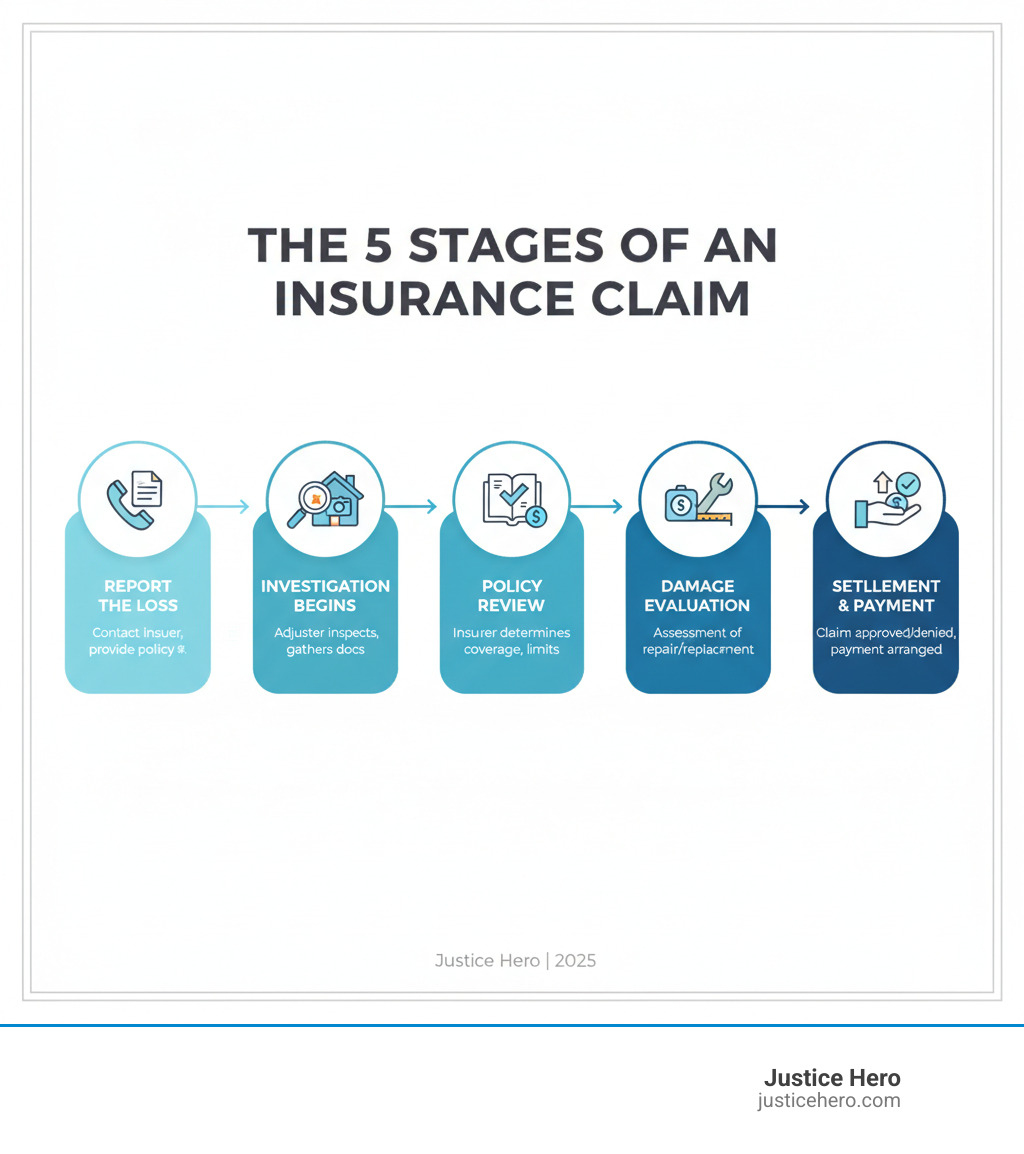
Your insurance policy is a legal contract defining your rights and the insurer's obligations. The claims process involves distinct stages: reporting, investigation, policy review, damage evaluation, and payment. Understanding how to communicate at each stage is critical for a fair and timely settlement.

Insurers must follow strict laws, including deadlines for responding to claims (often 10-15 days) and rules for how they investigate and justify decisions. Knowing these regulations allows you to hold your insurer accountable.

I'm Tim Burd, founder of Justice Hero. We help people steer complex legal and insurance situations. My experience shows that understanding the claims process empowers you to get the compensation you deserve. This guide will show you how to communicate effectively with your insurer and what to do when things go wrong.
Infographic showing the 5 main stages of an insurance claim: 1. Report the Loss - Contact your insurer immediately and provide your policy number, 2. Investigation Begins - An adjuster inspects damage and gathers documentation, 3. Policy Review - Insurer determines coverage, deductibles, and applicable limits, 4. Damage Evaluation - Final assessment of repair or replacement costs, 5. Settlement & Payment - Insurer accepts or denies claim and arranges payment if approved - Dealing with insurance companies infographic

Before You File: Understanding Your Policy and Preparing for a Claim

The best time to understand your insurance policy is before you need it. Waiting until a disaster strikes to learn your coverage is a costly mistake. Think of your policy as a toolkit; knowing what's inside prepares you for dealing with insurance companies effectively.

a person organizing documents and creating a home inventory list on a tablet - Dealing with insurance companies

Know Your Coverage Inside and Out

Your policy is a legal contract, and understanding key terms can save you thousands of dollars. The two most important are Replacement Cost Value (RCV) and Actual Cash Value (ACV).

Replacement Cost Value (RCV) pays the full cost to replace a damaged item with a new one, without deducting for age or wear. In contrast, Actual Cash Value (ACV) pays the current market value of your item, factoring in depreciation. For example, with an RCV policy, a 10-year-old roof is replaced with a new one at today's prices. With an ACV policy, you'd only receive the depreciated value of a 10-year-old roof. In California, ACV is typically defined as fair market value.

Feature Replacement Cost Value (RCV) Actual Cash Value (ACV)
Payout Basis Cost to replace with new, similar item Replacement cost minus depreciation (current market value)
Depreciation Not deducted Deducted
Example (Roof) Pays for a brand new roof, even if old one was 10 years old Pays for a 10-year-old roof's value, which is less than a new one
Benefit Higher payout, allows for full replacement Lower premium, but you bear the cost of depreciation

Beyond these, check for other critical coverages:

Prepare for a Smooth Claims Process

Preparation is your best defense. A smooth claims process often depends on your organization beforehand.

A critical warning: be cautious about signing an Assignment of Benefits (AOB) with a contractor. An AOB transfers your insurance claim rights to them, meaning they can negotiate with your insurer and file suit in your name without your input. You lose control. Never sign an AOB under pressure.

If your situation involves both property damage and personal injury, our guide on the Personal Injury Lawsuit Process can provide more context.

After a disaster, the claims process begins. Understanding each step makes dealing with insurance companies less intimidating.

Step 1: Reporting the Loss and Initiating the Claim

Prompt notification is a policy requirement. Call your insurer's claims hotline as soon as possible with your policy number and contact information. Provide a clear description of the loss.

You also have a duty to mitigate damage—preventing further harm. For example, tarp a damaged roof or board up a broken window. Save receipts for these temporary repairs, as they are typically reimbursable. However, do not begin permanent repairs until your insurer has inspected the damage.

a homeowner taking photos of a damaged roof with their smartphone - Dealing with insurance companies

Step 2: The Investigation and Working with an Adjuster

An insurance adjuster will be assigned to investigate your claim, determine coverage, and estimate repair costs. There are different types:

The adjuster creates a scope of loss, a preliminary damage assessment. Be present during their inspection to point out all damage and ensure it's documented. Take your own notes and photos.

If your claim involves injuries, our guide on the Accident Settlement Process can be a helpful resource.

Step 3: Protecting Yourself from Post-Disaster Fraud

Disasters attract scammers. Be wary of home repair fraud from aggressive contractors who appear at your door demanding upfront payment and pressuring you to sign contracts. Always slow down, get multiple bids from licensed and reputable contractors, check references, and never pay the full amount upfront. Be especially cautious about signing an Assignment of Benefits.

Also, watch for flood-damaged vehicles being sold as clean. Always run a VIN check through a service like Carfax before buying a used car to check its history. For more tips, learn more about disaster preparedness at Insure U. Being informed is the best way to avoid becoming a victim while dealing with insurance companies.

Mastering the Art of Dealing with Insurance Companies

After the initial investigation, the negotiation phase begins. This is where your preparation and communication skills are vital when dealing with insurance companies. You have more power in this process than you might think.

What to Do When You Disagree with the Settlement Offer

If you receive a low settlement offer, don't panic. This is a normal part of the process, and you have the right to push back.

  1. Review the offer carefully. Insurers must provide an itemized explanation. Check if it covers all damages and if the costs are realistic.
  2. Negotiate. The first offer is rarely the final one. State your disagreement clearly and back it up with evidence like independent contractor estimates and receipts.
  3. Communicate in writing. Emails and letters create a paper trail. After phone calls, send a summary email of what was discussed.
  4. Keep a detailed claim journal. Log every interaction: date, time, person, and topic. This journal is powerful evidence if a dispute escalates.

For claims involving injuries, our guide on Bodily Injury Settlement offers additional insights.

Understanding Your Rights and an Insurer's Obligations

Insurers must follow laws like the Fair Claims Settlement Practices Act. These aren't suggestions; they are legal requirements. Key obligations include:

Recognize bad faith tactics, such as denying a claim without investigation, unreasonable delays, or pressuring you into a lowball offer. If you suspect bad faith, you have legal recourse. The Residential Property Claims Guide from the California Department of Insurance provides more detail on your rights.

How to Effectively Complain When Dealing with Insurance Companies

If you hit a wall, it's time to formalize your complaint.

Escalating a Dispute: Your Options Beyond the Adjuster

If your adjuster and their supervisor won't resolve your issue, it's time to escalate. When dealing with insurance companies, dispute resolution is a ladder; when the lower rungs fail, you climb higher for more formal oversight.

a flowchart showing the dispute resolution ladder from internal complaint to legal action - Dealing with insurance companies

Using the Insurer's Internal Dispute Resolution Process

Every licensed insurer must have an internal dispute resolution process. Contact the company ombudsman or complaints liaison officer, whose job is to review unresolved disputes. Present your case factually with all your documentation.

If the internal review fails, request a final position letter that states the company's official decision and reasoning. This letter is often required before external bodies will intervene, as it shows you have exhausted the company's internal process.

Involving Third-Party and Regulatory Bodies

If the internal process fails, contact the California Department of Insurance (CDI). The CDI is the state regulatory body with the power to investigate, mediate, and discipline insurers. Filing a complaint with the CDI (Consumer Hotline: 1-800-927-4357) signals to the insurer that they are under regulatory scrutiny.

The CDI can investigate for violations of the Fair Claims Settlement Practices Regulations and may offer mediation services to help negotiate a resolution. Having the CDI review your case often motivates insurers to resolve the dispute.

When to Consider Hiring a Lawyer for Help Dealing with Insurance Companies

Not every claim needs an attorney, but you should consider hiring one in certain situations:

Many personal injury attorneys work on a contingency fee basis, meaning they only get paid if they win compensation for you. This makes legal help accessible. If your claim involves a vehicle accident, an Auto Accident Lawsuit may be necessary.

Frequently Asked Questions about Insurance Claims

Here are answers to common questions that arise when dealing with insurance companies.

What is the difference between Replacement Cost Value (RCV) and Actual Cash Value (ACV)?

RCV (Replacement Cost Value) pays to replace your property with a new, similar item, without deducting for age or wear. ACV (Actual Cash Value) pays what your property was worth right before the loss, factoring in depreciation. An RCV policy offers better protection but usually has a higher premium. Check your policy to see which coverage you have.

What should I do if my insurance company is unresponsive?

If your insurer is unresponsive, first document every contact attempt in a log. Follow up all calls with a summary email to create a paper trail. California regulations generally require insurers to respond to communications within 15 days. If they consistently fail to do so, file a complaint with the California Department of Insurance (Consumer Hotline: 1-800-927-4357). This often prompts a quick response.

Can my insurance company force me to use a specific repair shop?

No. In California, you have the right to choose your own repair shop. An insurer can recommend shops from their network, but they cannot force you to use them. If they do recommend a shop, they must inform you of your right to choose another. Get multiple estimates from licensed, reputable contractors you trust and make your own choice. The insurer must pay for reasonable and necessary repairs, regardless of who you choose. When dealing with insurance companies, remember it's your property, and you have the final say on who fixes it.

Conclusion

Dealing with insurance companies is manageable with the right knowledge. A fair settlement depends on understanding your policy, documenting your loss, and knowing your rights. This guide has covered the key steps: preparing before a loss, navigating the claims process, negotiating a settlement, and escalating a dispute when necessary. Your policy is a contract, and insurers have legal obligations they must meet.

Your most powerful tools are documentation and persistence. A detailed paper trail holds insurers accountable and protects your interests.

However, you don't have to handle complex situations alone. For significant damages, complex disputes, or suspected bad faith, professional help is essential. If you're struggling with an insurer after an accident, a motor vehicle accident attorney can fight for the compensation you deserve.

At Justice Hero, we connect people with the legal resources they need. Understanding your rights is the first step, but having an expert in your corner can make all the difference. You don't have to face insurance companies alone or settle for less than you are owed.

Accident Happened: Your First Steps to Safety and Claims

What to do accident: 10 Essential Safety Steps

Understanding What to Do After an Accident: Your Essential Safety and Claims Guide

What to do accident situations require immediate, clear-headed action. Knowing the right steps protects your safety, legal rights, and ability to recover fair compensation. The stress following a collision can lead to critical mistakes, such as leaving the scene, forgetting to document evidence, or admitting fault.

Here's your quick reference guide:

  1. Check for injuries and call 911 if needed.
  2. Move to safety and turn on hazard lights.
  3. Exchange information with other drivers.
  4. Document the scene with photos.
  5. Contact police to file a report.
  6. Notify your insurance company promptly.
  7. Seek medical attention, even if you feel fine.
  8. Keep detailed records of everything.
  9. Avoid admitting fault.

With roughly 5.25 million police-reported car accidents in the US in 2020, the financial and physical impact is staggering. Many accidents result in long-term injuries, making it crucial to protect your future recovery.

I'm Tim Burd, CEO of Justice Hero. We help connect accident victims with the legal resources they need. I've seen how having the right information at the right time can make all the difference in both physical recovery and financial outcomes for those navigating what to do accident situations.

Infographic showing 10 immediate steps after a car accident: 1. Check for injuries and call 911 if needed, 2. Move vehicles to safety and activate hazard lights, 3. Secure the scene with flares or warning triangles, 4. Exchange contact and insurance information with all parties, 5. Collect witness contact information, 6. Take photos of vehicle damage from multiple angles, 7. Document road conditions, weather, and traffic signs, 8. File a police report or get the report number, 9. Notify your insurance company within 24 hours, 10. Seek medical evaluation even for minor symptoms - what to do accident infographic

Immediate Actions at the Scene: Prioritizing Safety

In the moments after a collision, try to stay calm and focus. When considering what to do accident-wise, your first priority is always to protect yourself and others from further harm.

A person on the phone with 911 at an accident scene - what to do accident

Assess for Injuries and Call for Help

First, check yourself and your passengers for injuries. If it's safe, check on the occupants of other vehicles. Some serious injuries like whiplash or concussions may not have immediate symptoms. For this reason, it's wise to call 911 if anyone complains of pain, if there's significant vehicle damage, if you suspect impairment, or if you're simply unsure. Paramedics are trained to spot injuries you might miss.

Do not move a seriously injured person unless they are in immediate danger (e.g., from fire). Moving someone incorrectly can worsen their injuries. Keep them calm and wait for emergency services. When you call 911, provide your location, the number of vehicles, and the injury status.

Secure the Accident Scene

After assessing injuries and calling for help, your next job is to prevent a second accident. If your vehicle is drivable, move it out of traffic to the shoulder or a nearby parking lot. Immediately turn on your hazard lights to warn other drivers.

If you have an emergency kit, place reflective triangles or flares behind your vehicle to alert approaching traffic. If the vehicle cannot be moved, stay inside with your seatbelt fastened until police arrive. This is often safer than standing on the roadside. If you must exit your vehicle, move to a safe spot away from traffic, like behind a guardrail. Never stand between vehicles or in an active lane.

For additional guidance on handling the scene safely, the Insurance Information Institute offers helpful advice at What to do at the scene of an accident | III.org.

What to Do After an Accident: Documenting and Reporting

Once the scene is safe, the next phase in any what to do accident scenario is to carefully document the incident and report it properly. This step is your financial and legal protection against future disputes or unexpected repair bills.

A person taking a photo of vehicle damage with a smartphone - what to do accident

Gathering Essential Information from All Parties

Politely but thoroughly collect the following from each driver involved:

Also, get the names and contact information of any passengers. If there were witnesses, ask for their name and phone number; their statements can be invaluable. Don't feel pressured to use the first tow truck that arrives; you have the right to choose your own or use one recommended by your insurer.

The Importance of Photographic and Written Documentation

Your smartphone is your most valuable tool for gathering evidence. Take more photos than you think you need.

While the details are fresh, write down your own account of the accident. Note the date, time, location, and sequence of events. These notes will be crucial when you file your claim.

For additional guidance on protecting your rights, review the advice at Car Accident Legal Advice | JusticeHero.

When and How to Involve Law Enforcement

Getting an official police report provides an objective account that is valuable for insurance claims. You should always call the police if there are any injuries, significant property damage (often over $2,000), or if you suspect a crime like a hit-and-run or DUI. Also, call if a driver is uncooperative or if vehicles are blocking traffic.

If police respond, get the officer's name, badge number, and the police report number. Ask how to obtain a copy. If police don't attend minor accidents in your area, file a report at the nearest station or online as soon as possible.

When speaking to officers, be factual and honest, but avoid speculating on the cause or admitting fault. A simple "I'm sorry" can be misinterpreted as an admission of guilt. The full circumstances are often more complex than they first appear.

After addressing immediate safety in a what to do accident situation, you must deal with insurance companies and legal responsibilities. Taking the right steps now protects your rights and ability to secure fair compensation.

A person reviewing an insurance policy document - what to do accident

Initiating Your Insurance Claim

Notify your own insurance company within 24 hours. Prompt notification is often a policy requirement. When you call, have the information you gathered at the scene ready. Be careful what you say to any insurance adjuster; stick to the facts and do not speculate about fault. You are not obligated to give a recorded statement to the other driver's insurance company right away. You can politely decline and consult with your own insurer or legal counsel first. Understanding your own coverage (collision, comprehensive, deductibles) will help set expectations. For more details, see our guide on Auto Accident Claims | JusticeHero.

Your primary legal duty is to stop at the scene. Leaving is a serious offense. You must also render reasonable aid and exchange information. Beyond these basics, what to do accident-wise varies by location. For example, in California, you must report any accident involving injury, death, or over $1,000 in damage to the DMV within 10 days using the Report of Traffic Accident Occurring in California (SR-1) | DMV.ca.gov. Failure to do so can lead to license suspension. Insurance systems also vary, from "no-fault" systems in some Canadian provinces to "tort-based" systems elsewhere. Understanding your local Motor Vehicle Accident Laws | JusticeHero is essential.

The Serious Consequences of a Hit-and-Run

Leaving the scene of an accident, or a hit-and-run, carries severe penalties, including fines, license suspension, and potential jail time if injuries occurred. If you are the victim of a hit-and-run, call the police immediately with any details you have about the other vehicle. This police report is crucial. Your own uninsured motorist coverage (UM) or collision coverage may cover your damages. UM coverage is designed for this exact scenario and can cover medical bills and vehicle damage. Our guide on a Hit and Run Lawsuit | JusticeHero explains your options for pursuing compensation.

After the Scene: Next Steps for Your Health and Claim

What you do in the days and weeks following a what to do accident situation is critical for your physical and financial recovery.

Why Seeking Medical Attention is Crucial

Never skip a medical evaluation after an accident, even if you feel fine. Adrenaline can mask serious injuries like whiplash, concussions, or internal bleeding, which may not show symptoms for hours or days. Seeing a doctor serves two purposes: it protects your health by identifying hidden injuries early, and it creates an official medical record linking your injuries to the accident.

Insurance companies often dispute claims where medical care was delayed. By getting checked out promptly (ideally within 24 hours), you create crucial evidence for any potential personal injury claim. Follow your doctor's treatment plan completely, attend all appointments, and keep detailed records of all medical expenses. This strengthens your position when filing a [Personal Injury Claim | JusticeHero](https://justicehero.com/personal-injury-claim/).

What to do accident-wise if you suspect long-term injuries

Catastrophic injuries like traumatic brain injuries or spinal cord damage require a different approach. These cases involve a lifetime of potential costs, including ongoing medical care, rehabilitation, home modifications, and lost earning capacity. The financial impact can be devastating without full compensation.

Documenting these injuries means working with medical specialists to project future needs and costs. Proving future damages is complex, and insurance companies will fight these high-value claims vigorously. This is where experienced legal representation is vital. Keep meticulous records of everything: medical appointments, therapy sessions, daily pain journals, and all accident-related expenses. This paper trail is the foundation for proving the full scope of your damages, as outlined in the [Personal Injury Definition | JusticeHero](https://justicehero.com/personal-injury-definition/).

Frequently Asked Questions about Post-Accident Procedures

Here are answers to common questions people have when navigating the what to do accident process.

Should I accept a settlement offer from the other driver's insurance company?

No, not without a professional evaluation of your claim. Initial settlement offers from the at-fault driver's insurer are almost always too low. They are designed to close the case quickly and cheaply, and they rarely account for future medical bills, lost wages, or pain and suffering. Once you accept a settlement, you forfeit your right to seek further compensation, even if new injuries surface. Before signing anything, consult an expert who can determine your claim's true value. Our guide on [Auto Accident Claims | JusticeHero](https://justicehero.com/auto-accident-claims/) explains this process.

What if the other driver is uninsured or underinsured?

Your own insurance policy can protect you. Uninsured Motorist (UM) coverage applies when the at-fault driver has no insurance. Underinsured Motorist (UIM) coverage helps when their policy limits are too low to cover your damages. Additionally, your collision coverage will pay for your vehicle repairs (minus your deductible), regardless of who was at fault. If you lack these coverages, you can sue the driver directly, but collecting a judgment can be difficult if they have no assets.

How long do I have to file a claim after an accident?

Every state has a statute of limitations, which is a strict deadline for filing a lawsuit. If you miss it, you lose your right to sue. In California, for example, you generally have two years for personal injury claims. While that seems like a long time, evidence disappears and memories fade. Acting quickly is crucial. Insurance policies also have their own prompt reporting requirements. Don't wait to take action. Our guide on the [Car Accident Lawsuit Process | JusticeHero](https://justicehero.com/car-accident-lawsuit-process/) details the necessary timelines.

Conclusion

Knowing what to do accident situations arise is key to protecting your health, rights, and future. By following a clear set of steps, you can steer the aftermath with confidence.

Remember these key actions:

The road to recovery can be complex, but you don't have to steer it alone. At Justice Hero, we simplify legal topics to help you make informed decisions. We provide clear, actionable guidance on everything from dealing with uninsured drivers to understanding your state's specific laws.

For more information on your rights and legal options, explore our comprehensive guides on Personal Injury Law | JusticeHero. You deserve justice, and we're here to help you find it.

A person looking thoughtfully at a flowchart for legal steps - what to do accident

How to Report a Vehicle Accident Without Losing Your Mind

Vehicle Accident: 5 Smart Steps

Why Proper Vehicle Accident Reporting Protects Your Rights

A vehicle accident happens in seconds, but the aftermath can affect your life for years. The moments following a collision are chaotic, and it's easy to make costly mistakes that jeopardize your insurance claim or legal case.

Quick Answer: Essential Steps After a Vehicle Accident

  1. Stay Safe - Check for injuries and move to safety if possible
  2. Call 911 - Report injuries, significant damage, or disputes
  3. Gather Evidence - Take photos and collect witness information
  4. Exchange Information - Get driver details, insurance, and license plates
  5. Notify Your Insurer - Report the accident promptly to your insurance company

The statistics are sobering: over 6 million auto accidents occur annually in the United States, with about 3 million resulting in injuries. According to research, driver error contributes to approximately 93% of crashes, making proper documentation crucial for determining fault and liability.

The difference between a smooth insurance process and a nightmare often comes down to what you do in those first critical minutes after impact.

Many people don't realize that failing to report an accident properly can result in denied claims, legal complications, or even criminal charges. Insurance companies employ adjusters whose primary job is to limit compensation, which means every detail you document (or fail to document) matters.

I'm Tim Burd of Justice Hero. I've helped thousands steer the complex aftermath of vehicle accident cases. Most people are unprepared for what follows a collision, which is why proper reporting is critical for protecting your rights.

Infographic showing 5 immediate steps after a vehicle accident: 1. Stay Safe - check injuries and move to safety, 2. Call 911 - report to authorities, 3. Gather Evidence - photos and witness info, 4. Exchange Information - driver details and insurance, 5. Notify Insurer - report promptly to your company - vehicle accident infographic mindmap-5-items

Find more about vehicle accident:

Step 1: Prioritize Safety and Secure the Scene

In a vehicle accident, the first few moments are disorienting. It's natural to feel shaken, but what you do in these critical minutes can make all the difference for everyone's safety and your future claim.

emergency flares or cones on a road at dusk - vehicle accident

Take a deep breath and stay calm. Keeping your wits about you is your best asset right now.

Your first job is to check for injuries—start with yourself, then any passengers. Even if you feel fine, adrenaline can mask pain. If anyone is seriously injured, or if you're unsure, call 911 immediately. Some injuries like whiplash or concussions don't always show symptoms right away.

If everyone seems okay and your vehicle is still running, your next priority is moving to safety. Get your car out of traffic if you can do so safely—pull over to the shoulder or a parking lot. However, if moving your vehicle would destroy evidence (like skid marks) or is unsafe, leave it and get yourself and your passengers to safety.

Turn on your hazard lights right away to alert other drivers. If you have emergency flares or reflective triangles, place them about 100 feet behind your vehicle to give approaching drivers plenty of warning.

Even if the vehicle accident seems minor, call 911 anyway. This creates an official police report, which is invaluable when dealing with insurance companies. What looks like minor damage can hide serious issues, and official documentation protects you.

Special Hazards: What to Do in High-Risk Situations

Most accidents are straightforward, but some situations require special safety protocols. Knowing what to do in these rare scenarios can be life-saving.

Power lines are one of the most dangerous post-accident hazards. If your vehicle has struck a power pole or you see downed lines, assume they're energized.

If your car is drivable, move it at least 10 meters (33 feet) away from any downed power lines. This is a critical safety distance.

If your vehicle is immobile, stay inside your car and call 911. The rubber tires offer insulation, making it the safest place.

Only exit an energized vehicle if there's an immediate life-threatening emergency, like a fire. If you must get out, jump clear of the vehicle with both feet together, ensuring you don't touch the car and the ground simultaneously.

Once you land, keep your feet together and shuffle away without lifting either foot off the ground. This prevents creating an electrical circuit. Maintain that 10-meter distance until emergency responders arrive.

If you witness an accident involving power lines, stay at least 33 feet away, call 911, and encourage anyone in the vehicle to stay put. Approaching an energized vehicle puts you at serious risk.

One more critical point: never try to extinguish electrical fires with water or standard fire extinguishers. Leave these fires to professionals with the proper equipment.

Step 2: How to Report the Vehicle Accident to Authorities

Now that everyone is safe, it's time to get the official wheels turning. Reporting your vehicle accident to the authorities creates a paper trail that could make or break your insurance claim or legal case down the road.

police officer taking notes at an accident scene - vehicle accident

You should call the police whenever there's an injury or death, no matter how minor it seems. That headache might be nothing, or it could be the start of a concussion. It's also essential to call when there's significant property damage - and "significant" might be less than you think. Many states require police reports for damage over just a few hundred dollars.

Here's the thing about police reports: they're like having a neutral referee document what happened. The officer will note the time and location, interview everyone involved, talk to witnesses, and give their professional assessment of the scene. This isn't just paperwork - it's often the foundation your insurance company uses to determine fault and process your claim.

When the officer arrives, take a deep breath and stick to the facts. Describe what you saw, what you felt, and what happened in simple terms. But here's what you absolutely shouldn't do: avoid admitting fault, even if you're convinced you messed up. I've seen too many cases where someone said "I'm sorry" at the scene, only to find later that the other driver was actually speeding or ran a red light.

Think of it this way - you wouldn't diagnose your own broken arm, so don't diagnose legal fault at an accident scene. That's what investigators, insurance adjusters, and sometimes lawyers are for.

Before the officer wraps up, make sure you get their name, badge number, and the police report number. Write it down or put it in your phone immediately. You'll need this information to get a copy of the report later, and trust me, you'll want that report when you're dealing with insurance companies.

More info about Motor Vehicle Accident Laws.

Exchanging Information with the Other Party

While you're waiting for police or after they've finished their report, you need to become a detective. Gathering comprehensive information from everyone involved isn't just helpful - it's absolutely critical for your insurance claim and any potential legal action.

Start with the driver's name and contact information - get their full legal name, current phone number, and address. Don't just take their word for it; ask to see their driver's license and jot down the license number. This uniquely identifies them in the system.

Next, you need their insurance company and policy number. If they have their insurance card handy, take a photo of it with your phone. This saves you from scrambling to read tiny print while you're still shaken up. Make note of their license plate number and which state or province issued it.

Don't forget the vehicle details - write down the make, model, and year of their car. A "blue sedan" isn't nearly as helpful as "2019 Honda Accord" when you're filing paperwork later.

Here's where things get really valuable: witness names and contact information. If someone saw what happened, their unbiased account could be worth its weight in gold. Ask for their name, phone number, and email address. Most people are willing to help if you ask politely.

Throughout this process, keep things calm and professional. I know it's tempting to argue about who did what, but save your energy. Right now, you're just gathering facts, not fighting your case. There will be plenty of time for that later if needed.

Step 3: Documenting the Scene and Notifying Your Insurer

After ensuring everyone's safety and speaking with the authorities, it's time to become your own detective. Thorough documentation of the vehicle accident scene and prompt notification to your insurance company form the foundation of any successful claim. Think of this as building your case, one photo and one detail at a time.

person taking a photo of vehicle damage with a smartphone - vehicle accident

Your smartphone camera is your most valuable tool. We can't stress this enough: take photos of everything. Start with all angles of the vehicles involved, capturing both close-up shots of the damage and wider shots showing the entire vehicle. Don't just focus on the obvious damage; sometimes the most important evidence is less apparent.

Next, look for skid marks on the pavement, as these tell a story about speed and braking. If road conditions played a role, document them too. Was there standing water, ice, or construction debris? These road conditions could be crucial later.

Don't forget to photograph any relevant traffic signs and signals. A stop sign or traffic light could be a key piece of evidence. Take wide shots showing how the vehicles are positioned relative to traffic controls and road markings.

The goal is to create a visual record that tells the complete story. Insurance adjusters and attorneys need to understand the scene as if they were there.

Once you've documented everything, report to your insurance company immediately. Most policies have strict deadlines for reporting accidents, and missing them can jeopardize your claim.

When you call, have your information ready: the police report number, the other driver's details, witness contacts, and your photos. Provide the collected information accurately, but stick to the facts. Avoid speculating about fault or making statements that could be interpreted as admitting blame. Your insurer will launch its own investigation.

More info about Auto Accident Claim Lawyer.

Understanding the Causes of a Vehicle Accident

Understanding why collisions happen explains why thorough documentation and fault determination matter so much. It's about proving what caused the incident.

Human factors contribute to about 93% of crashes. This means most accidents are preventable incidents caused by human error, which is why many now use the term "collision" instead of "accident."

Driver error takes many forms. Distracted driving is an epidemic; drivers using mobile devices face nearly four times the crash risk. Speeding remains a persistent factor, contributing to 26% of all traffic deaths in 2018, according to NHTSA data on speeding. It reduces reaction time and increases impact severity.

Impaired driving from alcohol or drugs and drowsiness are other major dangers. While human error dominates, road design and vehicle maintenance issues can also play supporting roles.

Understanding these causes helps explain why the crash vs. accident terminology matters legally. Proving that negligence—carelessness—caused a collision allows injury victims to recover damages for their losses. That's where your careful documentation becomes invaluable evidence.

Once you've handled the immediate crisis and filed your initial reports, you enter the most challenging phase of a vehicle accident: dealing with the aftermath. This is where your careful documentation becomes your lifeline.

Fault determination is often complex. Insurance companies investigate using police reports, witness statements, photos, and their own findings. The outcome directly affects whose insurance pays.

Even if you're found partially responsible for the vehicle accident, you might still be entitled to compensation. Some jurisdictions offer "no-fault" benefits covering medical treatment and lost wages regardless of who caused the collision. Others follow comparative negligence rules, where your compensation is reduced by your percentage of fault.

Negligence—legal carelessness—is the cornerstone of most accident claims. If another's negligence caused your damages, you have grounds for a claim. However, insurance adjusters work to protect their company's bottom line, not maximize your compensation.

You'll typically encounter two main types of claims. Property damage claims cover fixing or replacing your vehicle and are usually straightforward. Personal injury claims are more complex, seeking compensation for medical expenses, lost wages, and "pain and suffering." The key to a successful personal injury claim is thorough medical records. Without proper documentation, proving the extent of your damages is nearly impossible.

Timing is also critical. Avoid accepting quick settlement offers before you fully understand the extent of your injuries, as some conditions take time to manifest.

More info about Personal Injury Motor Vehicle Lawsuit.

The legal consequences of a vehicle accident can affect your financial future for years. The statute of limitations is a strict legal deadline for filing a lawsuit, which varies by state. In California, you typically have two years from the date of injury for personal injury claims. Miss this deadline, and you lose your right to sue.

When negligence is established, you may be entitled to recover several types of damages. Medical expenses cover everything from the ambulance ride to ongoing physical therapy. Lost wages compensate for missed paychecks and reduced future earning capacity. Pain and suffering damages address the non-economic impact of your injuries, such as anxiety or loss of enjoyment of life.

Given the complexity of these issues, seeking legal representation often makes financial sense. An experienced attorney can help you steer insurance company tactics, meet critical deadlines, and fight for fair compensation, often recovering significantly more than you could on your own.

More info about Auto Accident Litigation.

Frequently Asked Questions about Vehicle Accidents

Even with the most comprehensive guide, we know that real-life situations after a vehicle accident can throw you curveballs that weren't covered. Over the years at Justice Hero, we've fielded thousands of questions from people dealing with the aftermath of collisions. Here are the most common concerns that keep people up at night.

What if the other driver is uninsured or underinsured?

This scenario is far more common than most people realize - roughly 1 in 8 drivers in the U.S. is driving without insurance. It's a sinking feeling when you find the person who hit you can't pay for your damages, but you're not necessarily out of luck.

Your own insurance policy may include Uninsured/Underinsured Motorist (UM/UIM) coverage, which can be a financial lifesaver in these situations. This coverage steps in to cover your damages and injuries up to your policy limits when the at-fault driver has no insurance or insufficient coverage. Think of it as insurance for your insurance.

The key is acting quickly. Report the accident to your insurer immediately and make it crystal clear that the other driver is uninsured or underinsured. Your insurance company will need to verify this information, and delays can complicate the process. If you don't own a vehicle yourself, some states maintain uninsured motorist funds that might apply to your situation, though these are typically limited.

What should I do if I believe I am partially at fault?

Here's the thing - even if you think you might have contributed to the vehicle accident, you should still follow every single reporting step we've outlined. The most important rule? Never admit fault at the scene or when speaking with the other driver's insurance company.

Fault determination isn't a gut feeling or an immediate judgment call. It's a legal process that considers all the evidence - police reports, witness statements, traffic laws, road conditions, and more. What might seem obvious to you in the moment could look completely different once all the facts are examined.

Many states operate under comparative negligence rules, which means you can still recover damages even if you were partially responsible. For example, if you're found 30% at fault, you might still be able to collect 70% of your damages. Every state handles this differently, so having a legal professional assess your specific situation can make a significant difference in the outcome.

How long do I have to file a claim or lawsuit after an accident?

Time is not on your side when it comes to legal action after a vehicle accident. Every state has what's called a statute of limitations - a strict deadline for filing a lawsuit. Miss this deadline, and you typically lose your right to seek compensation forever, regardless of how strong your case might be.

These deadlines vary dramatically depending on where you live and what type of claim you're filing. Personal injury claims in California, for instance, must be filed within two years of the injury date. Property damage claims might have a three-year window. Wrongful death cases often have even tighter restrictions - three years in Maryland but just one year in Washington D.C.

The clock usually starts ticking from the date of the accident, but there can be exceptions. Some injuries don't manifest symptoms immediately, and in rare cases, the timeline might begin when you find the injury was accident-related. This is why consulting with an attorney early is so important - they can help you understand the specific deadlines that apply to your situation and ensure you don't miss any critical windows for action.

Conclusion

The aftermath of a vehicle accident doesn't have to define your future. Yes, it's overwhelming when metal meets metal and your world suddenly shifts into chaos. But here's what I've learned from helping thousands of people through Justice Hero: the difference between a nightmare and a manageable situation often comes down to those first critical decisions you make.

By prioritizing safety first, you protect what matters most - human life. By gathering comprehensive evidence, you give yourself the ammunition needed to fight for fair compensation. By reporting promptly to both authorities and your insurance company, you create the official record that becomes your lifeline in the weeks and months ahead.

You're not just collecting information for the sake of it. Every photo you take, every detail you document, every witness contact you gather becomes a piece of evidence that protects your legal rights and financial future. Insurance companies have teams of adjusters whose job is to minimize what they pay out - but when you're prepared with thorough documentation, you level the playing field.

The legal system can feel intimidating, especially when you're dealing with injuries, vehicle repairs, and the stress of it all. That's exactly why Justice Hero exists. We believe that understanding your rights shouldn't require a law degree, and that every person deserves access to clear, actionable information when they need it most.

Don't let the complexity of a vehicle accident aftermath overwhelm you. Take it one step at a time, stay organized with your documentation, and remember that seeking help isn't a sign of weakness - it's a smart strategy for protecting your future.

Learn more about your legal options after an accident.

Your Essential Guide to Motor Vehicle Accident Laws

Motor Vehicle Accident Laws: 7 Critical Steps

When an accident occurs, our immediate actions significantly impact our legal standing. Understanding our legal responsibilities as drivers is crucial. Staying calm and following proper procedure is paramount.

What to Do Immediately After a Collision

First, stop your vehicle. Leaving the scene is a serious offense, often a hit-and-run, with severe legal consequences.

Once stopped, assess the situation. If safe and operable, move your vehicle to the side of the road to prevent further obstruction. If not, exit cautiously. Prioritize checking for injuries, both your own and others. If injuries or significant damage exist, immediately call 911 for emergency medical staff and law enforcement. It's also your legal and moral duty to render reasonable assistance to anyone injured, such as helping them to a safe spot or staying with them until help arrives.

Being prepared can save stress. We highly recommend keeping an accident checklist in your glove compartment. You can Download an accident checklist to guide you through the initial steps.

Reporting the Accident and Exchanging Information

Reporting the accident to law enforcement is often legally required, though specifics vary by state. Generally, a police report is needed for injuries, fatalities, or property damage exceeding a monetary threshold. For example, many states require a report if property damage exceeds a few hundred to a few thousand dollars (e.g., Mississippi $250, Nevada $750, Arizona $2,000). Even for minor incidents, a police report is invaluable for insurance claims and proving fault.

After ensuring safety and contacting authorities, exchange information with all other drivers involved. This typically includes:

Gather contact details from any witnesses, as their unbiased accounts can be crucial. Document the scene with photos or videos from various angles – showing vehicle damage, road conditions, traffic signs, and any visible injuries – to provide vital evidence. Providing false information in an accident report is illegal and can lead to serious penalties, including a suspended driver's license.

The Critical Mistake to Avoid: Admitting Fault

This is perhaps the most crucial piece of advice: never admit fault or express any opinions concerning fault at the scene of an accident. An apology or expression of remorse can be misinterpreted or used as evidence against you. Even a seemingly innocent "I'm so sorry!" could be twisted into an admission of responsibility.

Your role at the scene is to gather facts, ensure safety, and exchange information, not to determine who's to blame. Allow authorities and insurance adjusters to determine fault through objective investigations based on evidence and traffic laws. Stick to factual statements about what happened, and avoid speculating or discussing fault with anyone other than your attorney or insurance provider.

Understanding Fault, Negligence, and Liability

gavel resting on a vehicle code book - motor vehicle accident laws

Once the immediate stress of an accident fades, the legal process begins, focusing on fault and negligence. These terms determine who is responsible for damages and injuries. State laws vary significantly in assigning blame and handling compensation, making understanding your rights crucial.

How is Fault Determined in a Motor Vehicle Accident?

Fault in a car accident case is typically decided using negligence, which means failing to act as a reasonably careful person would in the same situation. If someone's carelessness causes harm, they are considered negligent.

To prove negligence in an accident claim, four main elements are generally needed:

  1. Duty: Every driver has a duty to drive safely and follow traffic rules.
  2. Breach: The at-fault driver broke that duty by not acting reasonably (e.g., speeding, texting while driving, running a red light).
  3. Causation: The driver's broken duty directly led to the accident and your injuries.
  4. Damages: You suffered actual losses because of the accident (e.g., medical bills, lost wages, car damage).

Police reports, witness statements, traffic camera footage, and accident reconstruction help determine fault. A traffic law violation often indicates a "breach" of duty. Establishing fault is the first step in a personal injury lawsuit, crucial for pursuing compensation.

State Systems: At-Fault vs. No-Fault Insurance

States generally use either at-fault (tort) or no-fault systems for insurance claims.

In an at-fault state, the driver who caused the accident is financially responsible for damages. Their insurance typically covers medical bills, car repairs, and other losses for those they injured. Most U.S. states, like Missouri and Nevada, use this system.

In a no-fault state, your own insurance policy, specifically Personal Injury Protection (PIP) coverage, pays for your medical expenses and lost wages, regardless of fault. This aims to speed up payments for minor injuries and reduce lawsuits. However, specific rules or injury levels may allow you to sue the at-fault driver for more serious damages, like pain and suffering. Kansas is a no-fault state requiring PIP coverage.

Here's a quick comparison of the main differences:

Feature At-Fault System No-Fault System
Payer for Injuries At-fault driver's insurance (or the at-fault driver directly) Your own PIP insurance, regardless of fault
Right to Sue Generally, yes, to recover all damages Limited; typically only for serious injuries or exceeding certain thresholds
Focus Determining who caused the accident Prompt payment of medical bills and lost wages
PIP Coverage Often optional or not required Mandatory

How State Negligence Rules Impact Your Compensation

Determining fault isn't always clear-cut; sometimes both drivers share responsibility. State-specific negligence rules significantly affect compensation.

  1. Contributory Negligence: Used by a few states (e.g., Maryland). If you are even 1% at fault, you cannot recover any damages from the other party. It's an all-or-nothing system.

  2. Pure Comparative Negligence: Allows an injured person to recover damages even if mostly at fault, but compensation is reduced by their percentage of fault. For example, 35% fault for $100,000 damages means $65,000 recovery. California uses this system.

  3. Modified Comparative Negligence: The most common system, with two versions:

    • 50% Bar Rule: In states like Georgia, Maine, Kansas, and Nevada, you cannot recover if you are 50% or more at fault. If 49% or less at fault, recovery is reduced by your fault percentage.
    • 51% Bar Rule: In states like Massachusetts and Wisconsin, you cannot recover if you are 51% or more at fault. If 50% or less at fault, recovery is reduced by your fault percentage.

Knowing which rule applies in your state is crucial, as it directly impacts potential bodily injury settlements.

person reviewing a settlement document with an attorney - motor vehicle accident laws

After an accident, the legal process of seeking compensation involves navigating insurance claims, understanding legal deadlines, and potentially litigation.

Filing a Claim and the Statute of Limitations

The statute of limitations is a critical deadline setting the maximum time to file a personal injury lawsuit or property damage claim. Missing this deadline generally waives your right to compensation.

This period varies widely by state, from one to six years. For example, Arizona and Kansas generally have a two-year limit for car accident claims, while Missouri offers five years for personal injury. Wrongful death claims often have different limits.

Exceptions exist, such as the "findy rule" for latent injuries or for minors. Claims against government agencies have significantly shorter deadlines (e.g., 30-90 days). Prompt action is always best, as evidence degrades and witnesses forget over time.

Types of Damages You Can Recover

Compensation after a motor vehicle accident refers to "damages," typically categorized as:

  1. Economic Damages: Quantifiable financial losses.

    • Medical Expenses: Emergency care, doctor visits, surgeries, physical therapy, medications, future medical care.
    • Lost Wages: Income lost due to inability to work, including lost earning capacity.
    • Property Damage: Costs to repair or replace damaged vehicle and other personal property.
  2. Non-Economic Damages: Subjective, non-monetary losses.

    • Pain and Suffering: Physical pain and emotional distress.
    • Emotional Distress: Anxiety, depression, fear, PTSD.
    • Loss of Enjoyment of Life: Inability to participate in hobbies or activities.
    • Loss of Consortium: Negative impact on spouse or family relationships.
  3. Punitive Damages: Rarely awarded, these punish egregious, reckless, or malicious conduct (e.g., drunk driving causing an accident) and deter future similar behavior.

When to Hire a Motor Vehicle Accident Attorney

While minor fender-benders might be handled directly with insurance, a motor vehicle accident attorney is often essential. Many injury victims forgo legal representation due to misconceptions about cost.

Consider hiring an attorney if:

Most motor vehicle accident attorneys work on a contingency fee basis, meaning no upfront fees. Their fees are a percentage of your recovery. If they don't win, you generally don't pay. This makes legal representation accessible. Initial consultations are typically free.

Critical State-Specific Motor Vehicle Accident Laws

map of the United States with several states highlighted - motor vehicle accident laws

Motor vehicle accident laws are not uniform across the U.S. While federal laws define what an accident is, most regulations governing how accidents are handled, who pays, and consequences fall under state jurisdiction. This means rights and responsibilities can change significantly by crossing state lines.

What are the motor vehicle accident laws for hit-and-run incidents?

A hit-and-run occurs when a driver leaves the scene without fulfilling legal duties (stopping, exchanging info, rendering aid). These are serious criminal offenses with severe penalties under motor vehicle accident laws.

Every state requires drivers to stop at an accident scene, regardless of fault, check for injuries, provide reasonable assistance, and exchange information. Failure to do so can lead to:

Driving under the influence (DUI) or driving while intoxicated (DWI) is a grave offense, especially when it leads to an accident. Every state has a legal Blood Alcohol Concentration (BAC) limit, typically 0.08% for most drivers (lower for commercial drivers or those under 21).

When a DUI causes an accident, consequences are amplified:

Understanding How Motor Vehicle Accident Laws Vary by State

Differences in motor vehicle accident laws profoundly impact everything from insurance to compensation.

Given this patchwork, understanding the specific laws of the state where an accident occurred is paramount.

Frequently Asked Questions about Motor Vehicle Accident Laws

Navigating motor vehicle accident laws can be complex. Here are common questions with clear answers to help you understand your situation.

What if the at-fault driver has no insurance or not enough?

The uninsured or underinsured driver scenario is frustrating. While most states require minimum liability insurance, not everyone complies.

If the at-fault driver has no insurance (uninsured) or insufficient coverage (underinsured), your options depend on your own car insurance policy.

Two key coverages are:

If you lack UM/UIM coverage, or if damages exceed those limits, you might pursue compensation directly from the at-fault driver's personal assets. This can be challenging if their financial resources are limited. Review your policy to ensure adequate protection.

Can I be sued personally for a car accident?

Yes, absolutely. If you are at fault and total damages (medical bills, lost wages, property damage, pain and suffering) exceed your auto insurance policy limits, the injured party can sue you personally for the difference.

This means your personal assets, like savings, home equity, or future wages, could be at risk. This highlights the importance of robust insurance coverage.

Many financial advisors recommend "umbrella insurance" policies, which provide an extra layer of liability coverage beyond your auto and homeowner's insurance, offering greater asset protection.

If sued, your auto insurance company typically provides a lawyer to defend you. However, their primary goal is to defend their financial exposure up to your policy limits, not necessarily to protect your personal assets beyond that.

How long does a motor vehicle accident lawsuit take?

The timeline for a motor vehicle accident lawsuit varies greatly, from a few months to several years.

Several factors influence the timeline:

While trial can be lengthy, many cases resolve through settlement, providing compensation within weeks or months. Your attorney will guide you in weighing settlement versus trial.

Conclusion: Protecting Your Rights After an Accident

Navigating the complexities of motor vehicle accident laws can certainly feel overwhelming. But by understanding the fundamental principles we've explored together, you're empowered to protect your rights and seek the justice you deserve. We've covered crucial first steps, fault determination, and compensation.

Key takeaways:

First, act promptly. Timely action—reporting, seeking medical attention, contacting legal professionals—preserves evidence and prevents missing deadlines.

Second, document everything. Photos, witness contacts, medical records, and police reports are vital for your case.

Third, understand fault and how negligence is proven. Your state's comparative or contributory negligence rules directly impact your compensation.

Fourth, know your state's laws. Motor vehicle accident laws vary significantly across states, from insurance minimums to reporting thresholds.

Finally, remember: you don't have to go it alone. The legal system is complex, and insurance companies aim to minimize payouts. A qualified motor vehicle accident attorney can be an invaluable ally, ensuring your rights are protected and you receive fair compensation. Most work on a contingency fee basis, making representation accessible.

At Justice Hero, we simplify complex legal topics, helping you make sense of it all and connect with needed legal resources.

Find comprehensive information on all lawsuits and empower yourself with knowledge.

Crash and Learn – Essential Legal Advice After an Auto Accident

Auto Accident Legal Advice | Justice Hero

Auto accident legal advice matters most in the first hours after a crash, when shock and adrenaline hide injuries and insurance adjusters rush to protect company profits. Knowing just a few basics can keep you from losing thousands of dollars later.

Essential steps after a crash:

Statistics are clear: people who hire an attorney receive about 3.5× more in compensation than those who handle claims alone. Because 90 % of personal-injury lawyers work on contingency, this help costs nothing up front.

Every year U.S. crashes cost victims over $57 k on average. When a claim is undervalued, families end up paying for medical bills, lost wages, rental cars, and higher premiums out of pocket. Proper legal guidance closes that gap, lets you focus on healing, and makes sure insurance companies pay what they owe.

Comprehensive infographic showing the complete post-accident timeline from immediate safety steps through final settlement, including when to call 911, evidence collection checklist, insurance reporting deadlines, medical evaluation timeline, and key decision points for hiring legal representation - auto accident legal advice infographic

Basic vocab for deeper reading:

First 5 Minutes After Impact: Safety, Reporting & Evidence

accident scene with emergency responders and evidence markers - auto accident legal advice

Everything you do right now shapes the value of your future claim. Follow this rapid-fire checklist:

  1. Stay safe. Turn on hazards; move cars only if traffic makes the scene dangerous.
  2. Call 911. A police report is priceless evidence and delayed injuries are common.
  3. Check everyone for injuries—but discuss facts, not fault.
  4. Exchange information: names, phones, addresses, driver’s license numbers, insurer, policy, plate, vehicle make/model/VIN.
  5. Document the scene. Use your phone for wide shots, close-ups, skid marks, road conditions, weather, and any visible injuries. Save dash-cam footage before it’s overwritten.
  6. Find witnesses and capture their contact info or a quick video statement.

Even low-speed collisions can cause whiplash or concussions that surface days later. Without photos and a police report, proving the connection becomes hard—and insurers know it. Spend five extra minutes gathering proof so you’re protected months down the road.

Need more detail? Our guide on auto accident claims breaks down each evidence step.

Seasoned lawyers all say the same thing: small mistakes early on cost big money later. Here are the essentials they wish every driver knew.

Do I Need a Lawyer for a Minor Crash?

Probably. Hidden injuries and lowball offers are the norm. Once you tell an adjuster you’re “fine,” it’s in the record forever. A free consultation costs nothing; undoing a bad settlement is almost impossible.

How Fault Is Determined

Police reports matter but aren’t final. States use comparative fault—if you’re 25 % at fault you still recover 75 % of your losses. Attorneys often overturn initial findings with surveillance video, black-box data, or new witnesses.

Statutes of Limitations

You generally have 1-4 years to sue depending on your state but some notice periods (e.g., claims against government vehicles) are as short as 30 days. Don’t gamble—know your deadline the week of the crash. If you’re unsure, our auto accident litigation primer lists every state’s limits.

Understanding your coverage before an accident is half the battle. Afterward, it’s all about documentation and negotiation.

Key Coverages in Plain English

What If the Other Driver Is Uninsured?

Your UM/UIM policy steps in. Without it, recovery is tough; most uninsured drivers have few assets. State compensation funds exist but pay small amounts and take time.

Settlement Numbers: Why They Jump With Lawyers

Insurance software spits out low first offers. A well-documented demand letter—medical records, wage proofs, photos—quickly multiplies those figures. Most cases settle without court once the insurer sees you’re organized and, if needed, backed by counsel. Details on building a winning demand are in our auto accident lawsuit guide.

Costs, Fees & Choosing the Right Car Accident Lawyer

attorney and client shaking hands in office setting - auto accident legal advice

How Contingency Fees Work

You pay nothing upfront. The lawyer advances costs and receives 33-40 % of the recovery only if they win. Because payouts average 3.5× higher with counsel, most clients still net more than if they went solo.

Picking the Right Lawyer

Green lights: dedicated accident practice, clear fee explanation, solid trial record, responsive communication. Red flags: pressure to sign, guarantees of huge checks, or no courtroom experience.

Short on cash? Legal-aid clinics, bar-association referrals, and most personal-injury firms all offer free initial consultations. Explore options before deciding.

Frequently Asked Questions – Quick Roundup

Do I Have to Report a Minor Accident?

Yes. File a police report and notify your insurer within 24-48 hours. Skipping either step can void coverage or let the other driver rewrite history.

How Long Will My Case Take?

Minor, clear-fault claims often settle in 3-6 months. Serious injuries or liability fights can stretch 12-24 months. Never settle until you know the full cost of treatment.

Will I End Up in Court?

Probably not. Over 90 % of cases resolve through negotiation or mediation. But having a lawyer ready for trial forces insurers to raise their offers.

Conclusion & Next Steps

Detailed infographic summarizing the complete auto accident claims process from immediate post-crash steps through final settlement, including decision trees for when to hire an attorney, typical timeline milestones, and key documentation requirements - auto accident legal advice infographic

Navigating the aftermath of an auto accident doesn't have to be overwhelming when you have the right information and support. The key is taking proper action in those critical first hours and understanding when professional legal help becomes essential.

Remember the fundamentals:

The statistics don't lie: Victims with legal representation recover 3.5 times more compensation on average. With contingency fee arrangements, quality legal help is accessible regardless of your financial situation.

At Justice Hero, we've dedicated ourselves to simplifying complex legal topics and connecting accident victims with qualified representation. Our mission is ensuring that corporate wrongdoing and insurance company tactics don't prevent families from receiving the justice and compensation they deserve.

Your next steps:

  1. If you haven't already, seek medical attention for any injuries
  2. Gather and organize all accident-related documentation
  3. Review your insurance policy to understand your coverage
  4. Consider consulting with a qualified attorney, especially if you have injuries, disputed liability, or insurance company resistance
  5. Keep detailed records of all expenses and communications

Every case is unique. What works for one accident victim may not apply to your situation. The most important auto accident legal advice we can offer is this: don't steer this process alone when professional help is available at no upfront cost.

For more information about your legal options, explore our comprehensive resources on all lawsuits we cover. Your recovery and your family's financial security are too important to leave to chance.

The road to recovery starts with taking the right steps today. You've got this, and we're here to help when you need us.